Assumption Limitations
As the core driving force of artificial intelligence, machine learning has achieved remarkable accomplishments in fields such as image recognition, natural language processing, and recommendation systems.
However, like any powerful tool, machine learning is not a panacea. Its effectiveness depends to a large extent on a series offundamental assumptions. When real-world data or problem scenarios violate these assumptions, the model's performance will be greatly compromised, or even yield completely wrong conclusions.
Understanding these limitations and boundaries, especially theassumption limitationsbehind them, is crucial for correctly and safely applying machine learning. This not only helps us avoid pitfalls, but also guides us in choosing more appropriate models or improving data, thereby building more robust and trustworthy intelligent systems.
Independent and Identically Distributed (IID) Assumption
This is one of the most core assumptions in supervised learning.
Basic Concepts
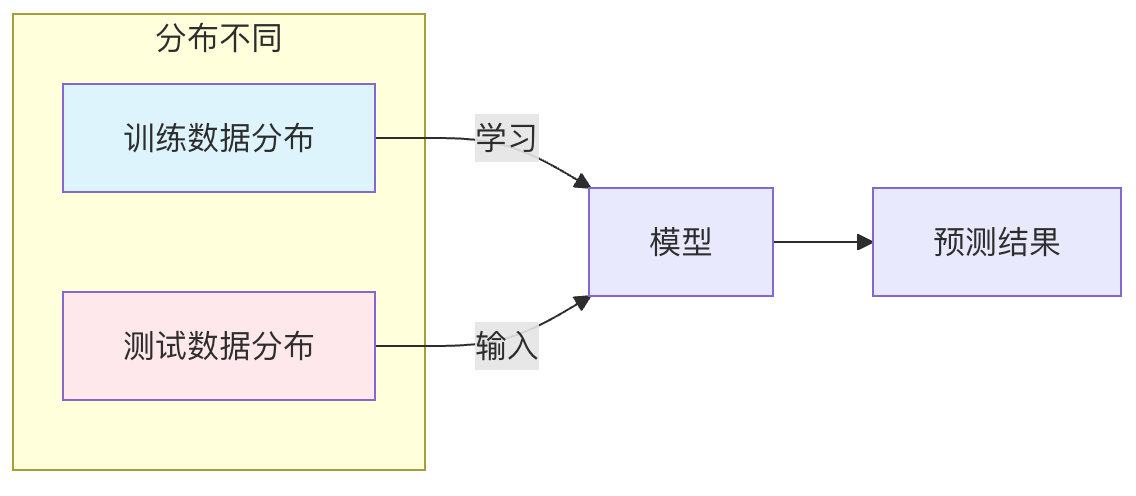
The IID assumption states that: the data samples we use to train the model and the data samples the model will predict in the future arefrom the sameprobability distributionindependentlydrawn.
- IndependenceThe occurrence of one data sample does not affect the probability of another data sample occurring.
- Identical DistributionAll data (training set, validation set, test set, and future real data) follow the same underlying data generation rule.
Why It Matters
The essence of a machine learning model is to learn the underlying data distribution rule by analyzing training data. If training data and test data come from different distributions, it means the rules learned by the model do not apply to the test scenario, and its prediction results will be unreliable.
Consequences and Examples of Assumption Violations
When this assumption is broken, adistribution shiftproblem occurs, mainly in the following types:
Covariate Shift
- Description: The input features
Xhave changed in distribution, but the relationship between the inputXand the outputY(i.e., the conditional distributionP(Y|X)) remains unchanged. - Example: A cat and dog classifier was trained on a dataset of clear images taken during the day, and then used to recognize blurry images taken at night. Here, the distribution of image clarity and lighting (features
X) has changed dramatically, but the visual features of "cats" and "dogs" themselves (the relationshipP(Y|X)) has not changed. The model may perform poorly because it is unfamiliar with blurry nighttime features.
Label Shift
- Description: The output labels
Yhave changed in distribution, but given the label, the distribution of input featuresP(X|Y)remains unchanged. - Example: A disease diagnosis model was trained on a dataset where healthy people account for 99% and diseased people account for 1%. In another region, the prevalence of the disease may rise to 10%. Although for truly diseased people, their symptoms (
P(X|Y=患病)) are similar, the model has seen too few "diseased" samples before, and may severely underestimate the disease probability in new data.
Concept Shift
- Description: The mapping relationship between the input
Xand the outputYitself changes over time or with the environment. - Example: Stock price prediction model. The market rules affecting stock prices (
P(Y|X)) are dynamic and change over time. A model trained on the past decade of data may not accurately predict future stock price trends under entirely new economic policies.
Training Data Representativeness Assumption
This assumption requires thatthe training dataset must fully represent the entire data space that the model may encounter.。
Basic Concepts
A model can only learn from data it has "seen." If the training data lacks certain important scenarios, categories, or feature ranges, the model will be at a loss when facing these "unseen" situations.
Consequences and Examples of Assumption Violations
This directly leads topoor generalization abilityandand biasproblems.
Incomplete Data Coverage
- Example: In the dataset used to train an autonomous driving perception model, if images of extreme weather such as heavy rain and heavy snow are missing, then when the model encounters such weather, its ability to recognize pedestrians and vehicles will significantly decline, or even fail.
Sample Selection Bias
- Description: The data collection method systematically excludes certain groups.
- Example: If the training data of a facial recognition system mainly comes from adults of specific skin tones and age groups, its accuracy will be significantly lower when recognizing children, elderly people, or people of other skin tones. This is not because the model is "bad," but because it has not had the opportunity to learn the features of these groups.
Stationarity Assumption
This assumption mainly targets time series data and requires thatthe basic statistical properties of the data (such as mean and variance) do not change over time.。
Basic Concepts
Many classical time series models (such as ARIMA) or machine learning models applied to sequence data implicitly assume that the data generation process is stationary, or can be made stationary through methods such as differencing.
Why It Matters
Trends or seasonality in non-stationary data dominate the model's learning process, causing the model to capture these spurious patterns that change over time rather than true intrinsic relationships, thus making poor predictions about the future.
Consequences and Examples of Assumption Violations
- Example: Predicting monthly ice cream sales. The data shows a clear upward trend (possibly due to company growth) and summer peaks. If non-stationary data is used directly for modeling, the model may simply predict that next month will be higher than this month, unable to accurately distinguish between long-term trends, seasonal effects, and true random fluctuations. Once the market becomes saturated (the trend changes), the predictions will be completely wrong.
Assumption of Correlation Between Features and Labels
This assumption is what enables machine learning to work — thefundamental prerequisite:the features we provideXmust have some correlation with the labels we want to predictYthat can be learned by the model.
Basic Concepts
The task of a machine learning model is to discoverXandYthis association pattern between them. If the two are essentially unrelated, no model can make predictions better than random guessing.
Consequences and Examples of Assumption Violations
- Example: Trying to use the color of a coffee cup to predict whether the stock market will rise or fall tomorrow. There is almost no meaningful causal relationship or stable statistical association between these two variables, so no matter what advanced model is used, the results are invalid.
Practical Exercise: Diagnose Your Problem
Before starting a machine learning project, please first consider the following checklist of questions to assess potential assumption limitation risks:
- Data Source Consistency: Were my training data (historical data) and future application scenario data produced under the same conditions? Are there unconsidered environmental, temporal, or group differences?
- Data Completeness Check: Does my training set contain all possible important categories and edge cases? Are there systematic omissions in the data collection process?
- Relationship Reasonableness: From the perspective of business logic or common sense, are the features I selected truly related to the prediction target?
- Stability Assessment: If my data is a time series, do its statistical properties (such as the mean) fluctuate drastically over time?
Summary
Recognizing the assumption limitations of machine learning is not to deny its value, but to use itmore scientificallyandmore responsibly. In practical applications, absolutely perfect assumptions almost never exist. Our goal is to, throughdata preprocessing(such as data augmentation, resampling),algorithm selection(such as algorithms robust to distribution shift), andcontinuous model monitoring and evaluation,to mitigate the impact of these assumption violations as much as possible.
An excellent machine learning practitioner is not only a master of parameter tuning, but also a data detective who deeply understands the boundaries of data, problems, and models. Understanding these limitations is the necessary path from beginner to mastery.
Other Extensions