Deep Learning vs Traditional Machine Learning
Imagine you are teaching a child to recognize cats and dogs. The traditional approach might be: you take out a picture book, point at the images and say this is a cat, it has pointed ears, whiskers, and a long tail; this is a dog, its ears may droop, and its nose is longer. You are explicitly telling the child the distinguishingrules and features。
The other approach is: you show the child thousands of images of cats and dogs, simply telling him or her whether each image is a cat or a dog. After enough observations, the child's brain will itself summarize the ineffable, complex distinguishing features of cats and dogs, such as fur texture, eye expression, and body contour. This approach is closer toletting the data speak for itself。
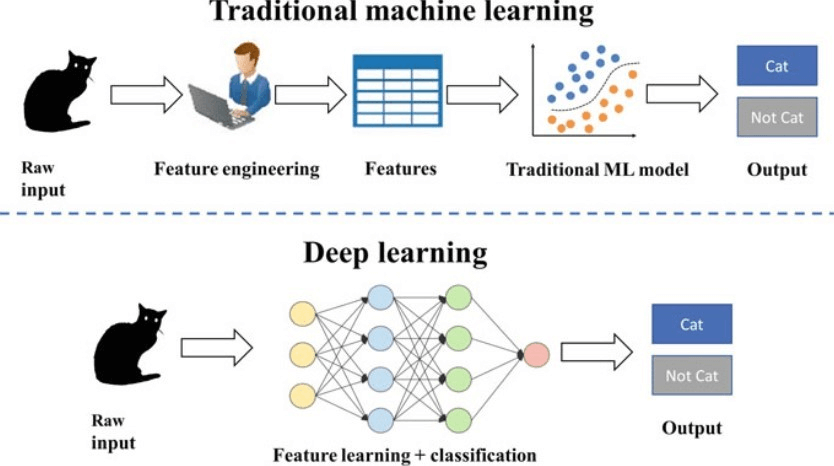
These two teaching methods correspond exactly to two important paradigms in the field of machine learning:traditional machine learninganddeep learning. This article will clearly parse the core ideas, working principles, advantages and disadvantages, and applicable scenarios of both for beginners, helping you build a macro-level understanding and choose a direction for subsequent learning.
Part 1: Traditional Machine Learning — The Analyst Based on Rules and Features
Traditional machine learning can be seen as an analyst who needs clear instructions and structured data.
What is Traditional Machine Learning?
Traditional machine learning is a collection of algorithms whose core idea is:to learn patterns (models) from data and use these patterns to predict or make decisions on new data. Its success depends heavily on a prerequisite and critical step:feature engineering。
Core Workflow
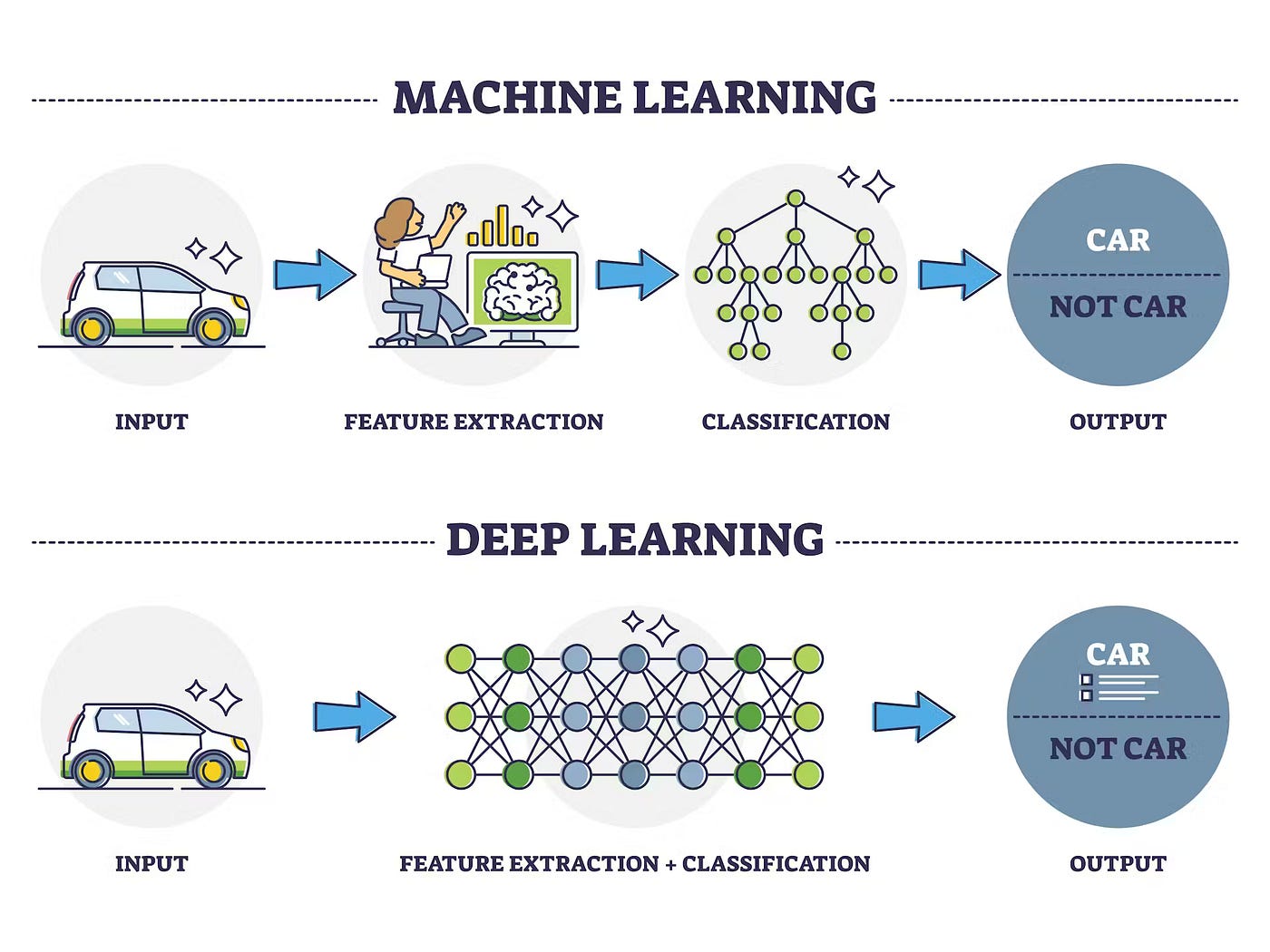
Let us intuitively understand the working process of traditional machine learning through a flowchart:
Flow Analysis:
- Feature Engineering: This is the core and most human-expertise-dependent stage. You need to extract quantifiable features that are helpful for solving the problem from raw data (e.g., image pixels, text words). For example, in spam detection, features might include whether the word "free" appears, or whether the sender's address is in the contacts list.
- Algorithm Selection and Training: Feed the processed feature data into a selected algorithm (e.g., Support Vector Machine, SVM, or Decision Tree). The algorithm will try to find a function or rule that can best predict the outcome (e.g., spam or not) based on these features.
- Prediction: When a new email arrives, the system first extracts the same features, and then hands them to the trained model for judgment.
Main Characteristics, Advantages and Disadvantages
| Characteristic | Description | Advantages | Disadvantages |
|---|---|---|---|
| Strong dependence on feature engineering | The upper limit of model performance is determined by feature quality. | Strong interpretability, and human expert knowledge can be integrated. | Requires a lot of domain knowledge and time for feature design and extraction; high cost. |
| Relatively simple models | Usually use linear models, tree models, etc. | Fast training speed, requiring fewer computational resources. | Handlingunstructured data(images, audio, natural language) is limited, making it difficult to capture deep and complex patterns. |
| Good interpretability | You can understand how the model makes decisions (e.g., the rule path of a decision tree). | Crucial in fields that require decision explanation, such as finance and healthcare. | Sometimes a portion of prediction accuracy is sacrificed in pursuit of interpretability. |
Simple analogy: Traditional machine learning is like ananalyst who has powerful formulas and statistical tools, but for whom you must personally prepare all the analysis materials.。
Part 2: Deep Learning — The Perceiver That Learns Automatically
Deep learning is a subfield of machine learning that attempts to mimic the way neurons in the human brain work, allowing machines to automatically learn multi-level feature representations from raw data.
What is Deep Learning?
The core of deep learning isartificial neural networks, especially deep neural networks with many layers. Its greatest characteristic is that it can learnend-to-end: you input the most raw data (e.g., raw pixels of an image), and it can output the final result (e.g., image category). The complex feature extraction process in between is automatically completed by the network.
Core Working Architecture
Deep learning, especially convolutional neural networks for image recognition, has a hierarchical learning process that goes from shallow to deep:

Architecture Analysis:
- Hierarchical Feature Learning: The first layer of the network may only learn to recognizeedges and corners. The second layer combines these edges and learns to recognizesimple textures and shapes(such as circles, stripes). Deeper layers then combine these simple shapes intocomplex parts and objects(such as eyes, car doors). The final layers combine these parts into completeobject concepts(such as cats, cars).
- End-to-End Learning: You do not need to tell the network what edges or textures are. You only need to provide a large amount of labeled raw data (images and corresponding cat/dog labels). Through thebackpropagationalgorithm, the network automatically adjusts its internal millions or even billions of parameters, and learns by itself which pixel combination patterns correspond to cats and which to dogs.
Main Characteristics, Advantages and Disadvantages
| Characteristic | Description | Advantages | Disadvantages |
|---|---|---|---|
| Automatic Feature Engineering | Can automatically learn multi-level, abstract features from raw data. | Eliminates tedious manual feature engineering; performs exceptionally well especially in processing images, speech, and text. | Like a "black box", the internal decision-making process is difficult to explain. |
| Strong ability to process unstructured data | Naturally suited to processing complex data such as pixels, sound waves, and word sequences. | Achieves or even surpasses human-level performance in fields such as computer vision, natural language processing, and speech recognition. | Requiresmassive amounts of datafor training; when data is insufficient, it tends to perform poorly. |
| Complex models with many parameters | Deep network layers containing a large number of neurons and connections. | Can model extremely complex and nonlinear relationships, with huge potential. | Training takes extremely long and requires powerful computational resources (e.g., GPU), and model deployment also requires a certain amount of computing power. |
| Poor interpretability | It is difficult to understand why the model makes a particular judgment. | - | Application is limited in fields that require strict explanation (such as credit approval and disease diagnosis). |
Simple analogy: Deep learning is like aperceiver with a multi-layer information processing network that can grow through extensive observation, but the process by which it reaches conclusions is not very transparent.
Part 3: Key Comparison and How to Choose
Now, let us put the two side by side for direct comparison and give selection suggestions.
Core Difference Comparison Table
| Comparison Dimension | Traditional Machine Learning | Deep Learning |
|---|---|---|
| Data Dependency | Relatively low requirement on data volume; suitable for small and medium-sized datasets. | Extremely dependent on big data; the more data, the better performance usually is. |
| Feature Processing | ManualFeature engineering is the key and main burden. | AutomaticPerforms feature extraction and abstraction. |
| Computational Resources | Usually runs efficiently on CPU; low requirements. | Requires powerful GPUs for training; high computational cost. |
| Model Interpretability | Good; the decision process is relatively transparent. | Poor; often regarded as a "black box model". |
| Problem Domain | Good at handlingstructured data(tabular data, scenarios with clear features). | Good at handlingunstructured data(images, audio, text, video). |
| Training Time | Relatively short, from minutes to hours. | Usually very long, from hours to weeks or even longer. |
| Entry Barrier | Relatively low; easy to understand and implement prototypes. | Relatively high; requires understanding complex knowledge such as neural networks and hyperparameter tuning. |
Practical Selection Guide: Which Should I Use?
You can follow this decision-making approach:
What type is your data?
- If it isstructured tabular data(such as Excel sheets containing columns like age, income, purchase history), prioritize traditional machine learning (e.g., gradient boosting trees XGBoost, random forests).
- If it isimage, speech, text, or sequence data, deep learning (CNN, RNN, Transformer) is usually the better choice.
How much data do you have?
- When data volume is limited (thousands to tens of thousands of samples), traditional machine learning tends to be more robust.
- With massive amounts of data (hundreds of thousands or more), deep learning's power can be fully unleashed.
Do you have requirements for model interpretability?
- In scenarios such as financial risk control and medical-assisted diagnosis, where you must be able to explain why a loan was rejected or why this disease is suspected, traditional machine learning is the safer choice.
- In scenarios such as image classification, voice assistants, and recommendation systems, where performance is prioritized and black-box models are acceptable, deep learning has the advantage.
What about your computational resources?
- If you don't have a powerful GPU and sufficient time, starting with traditional machine learning is the more practical choice.
One-sentence summary:Traditional machine learning is the art of data analysis, while deep learning is the science of perception and representation.They are not substitutes for each other but complementary toolboxes. A good AI practitioner should choose the most appropriate tool from the toolbox based on the specific problem.
Other extensions