Java Examples - Producer/Consumer Problem
 Java Examples
The producer-consumer problem is a classic problem in threading models: producers and consumers share the same storage space during the same time period. As shown in the figure below, the producer stores data into the space while the consumer takes data. If not coordinated, the following situation may occur:
The storage space is full, and the producer occupies it; the consumer waits for the producer to give up space to remove products, while the producer waits for the consumer to consume products so it can add products to the space. They wait on each other, resulting in a deadlock.
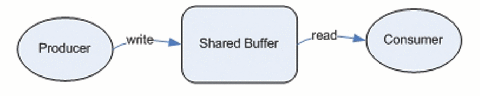
The following example demonstrates how to solve the producer/consumer problem using threads:
Example
/*
author by example.com
ProducerConsumerTest.java
*/
public class ProducerConsumerTest {
public static void main(String[] args) {
CubbyHole c = new CubbyHole();
Producer p1 = new Producer(c, 1);
Consumer c1 = new Consumer(c, 1);
p1.start();
c1.start();
}
}
class CubbyHole {
private int contents;
private boolean available = false;
public synchronized int get() {
while (available == false) {
try {
wait();
}
catch (InterruptedException e) {
}
}
available = false;
notifyAll();
return contents;
}
public synchronized void put(int value) {
while (available == true) {
try {
wait();
}
catch (InterruptedException e) {
}
}
contents = value;
available = true;
notifyAll();
}
}
class Consumer extends Thread {
private CubbyHole cubbyhole;
private int number;
public Consumer(CubbyHole c, int number) {
cubbyhole = c;
this.number = number;
}
public void run() {
int value = 0;
for (int i = 0; i < 10; i++) {
value = cubbyhole.get();
System.out.println("Consumer #" + this.number+ " got: " + value);
}
}
}
class Producer extends Thread {
private CubbyHole cubbyhole;
private int number;
public Producer(CubbyHole c, int number) {
cubbyhole = c;
this.number = number;
}
public void run() {
for (int i = 0; i < 10; i++) {
cubbyhole.put(i);
System.out.println("Producer #" + this.number + " put: " + i);
try {
sleep((int)(Math.random() * 100));
} catch (InterruptedException e) { }
}
}
}
author by example.com
ProducerConsumerTest.java
*/
public class ProducerConsumerTest {
public static void main(String[] args) {
CubbyHole c = new CubbyHole();
Producer p1 = new Producer(c, 1);
Consumer c1 = new Consumer(c, 1);
p1.start();
c1.start();
}
}
class CubbyHole {
private int contents;
private boolean available = false;
public synchronized int get() {
while (available == false) {
try {
wait();
}
catch (InterruptedException e) {
}
}
available = false;
notifyAll();
return contents;
}
public synchronized void put(int value) {
while (available == true) {
try {
wait();
}
catch (InterruptedException e) {
}
}
contents = value;
available = true;
notifyAll();
}
}
class Consumer extends Thread {
private CubbyHole cubbyhole;
private int number;
public Consumer(CubbyHole c, int number) {
cubbyhole = c;
this.number = number;
}
public void run() {
int value = 0;
for (int i = 0; i < 10; i++) {
value = cubbyhole.get();
System.out.println("Consumer #" + this.number+ " got: " + value);
}
}
}
class Producer extends Thread {
private CubbyHole cubbyhole;
private int number;
public Producer(CubbyHole c, int number) {
cubbyhole = c;
this.number = number;
}
public void run() {
for (int i = 0; i < 10; i++) {
cubbyhole.put(i);
System.out.println("Producer #" + this.number + " put: " + i);
try {
sleep((int)(Math.random() * 100));
} catch (InterruptedException e) { }
}
}
}
The output of running the above code is:
消费者 #1 got: 0 生产者 #1 put: 0 生产者 #1 put: 1 消费者 #1 got: 1 生产者 #1 put: 2 消费者 #1 got: 2 生产者 #1 put: 3 消费者 #1 got: 3 生产者 #1 put: 4 消费者 #1 got: 4 生产者 #1 put: 5 消费者 #1 got: 5 生产者 #1 put: 6 消费者 #1 got: 6 生产者 #1 put: 7 消费者 #1 got: 7 生产者 #1 put: 8 消费者 #1 got: 8 生产者 #1 put: 9 消费者 #1 got: 9Other Extensions