Pi Agent Introduction
Pi Agent (full name Pi Coding Agent, hereinafter referred to as Pi) is a minimalist terminal AI coding assistant that helps you complete coding tasks through natural language conversations in the command-line interface.
Pi Agent is developed by the earendil-works team. The core code remains streamlined while supporting various workflows through an extensible plugin system.
Pi is an AI coding agent that runs in the terminal, similar to tools like Claude Code and OpenAI Codex CLI.
Pi's official philosophy is:"There are many agent harnesses but this one is yours"(There are many agent tools, but this one is your own.)
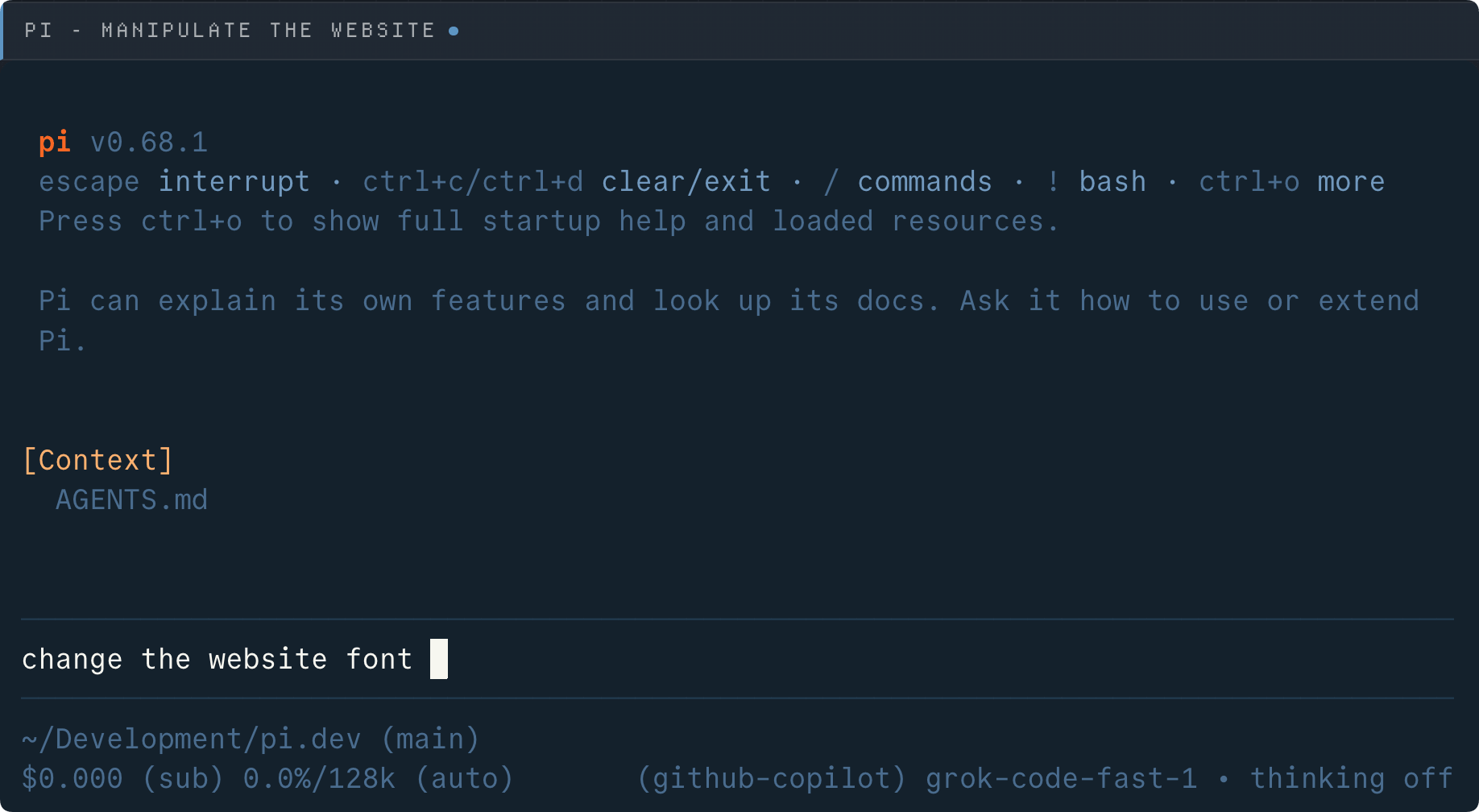
What is Pi Agent
Pi Agent is a programming assistant that runs in the terminal.
You can start it in your project directory and describe your requirements in natural language. It will read your code, execute commands, and modify files, working like a collaborative developer.
Its core design principles are:Keep the core minimal, with workflow-related features implemented through Extensions, Skills, Prompt Templates, and Themes rather than being built into the core.
Pi Agent intentionally does not include built-in features such as MCP, sub-agents, permission dialogs, Plan mode, to-dos, and background Bash.
If you need these workflows, you can install them via extensions or packages.
Differences Between Pi Agent and Other Tools
Pi Agent is positioned similarly to, but also different from, the following tools:
| Comparison Dimension | Pi Agent | Claude Code | GitHub Copilot / Codex CLI |
|---|---|---|---|
| Operation Mode | Terminal TUI | Terminal TUI | Terminal TUI |
| Core Size | Minimalist, no built-in MCP/sub-agents, etc. | Feature-rich (Hook, MCP, sub-agents, etc.) | Medium |
| Extension Method | TypeScript Extensions + Skills + Packages | Hook + MCP Server + Skills | Skills + MCP |
| Supported AI Providers | 30+ providers (subscription + API Key) | Mainly Anthropic API | GitHub Copilot / OpenAI |
| Session Management | Tree-like branching, supports fork/clone | Linear + branch recovery | Basic session management |
| Package Ecosystem | Yes (npm/git distributed packages) | No built-in package management | Skills Repository |
| Local Model Support | Built-in llama.cpp support | Mainly built-in cloud providers | Mainly built-in cloud providers |
Core Features Overview
Pi Agent's core features cover operation modes, provider integration, built-in tools, extension system, and theme customization, which are sufficient to support daily terminal programming work.
| Feature | Description |
|---|---|
| Multi-mode Operation | Interactive mode, Print mode (-p), JSON mode, RPC mode |
| Rich AI Providers | Supports 30+ providers including Anthropic, OpenAI, Google Gemini, DeepSeek, Groq, xAI, Mistral, etc. |
| Built-in Programming Tools | Four built-in tools are enabled by default: read (read files), write (write files), edit (edit files), bash (execute commands). grep, find, and ls are read-only tools that can be optionally enabled. |
| TypeScript Extensions | Custom tools, event hooks, command registration, UI interactions |
| Skills System | Compatible with the Agent Skills standard, loads specialized capabilities on demand |
| Tree-like Sessions | Supports branching, cloning, and deprecated branch summaries, making it easy to explore different approaches |
| Prompt Templates | Reusable Markdown prompts, supports parameter substitution |
| Theme Customization | 51 color tokens, supports dark/light themes and custom color schemes |
| Package Management | Install and share extensions, skills, templates, and themes via npm/git |
| Local Models | Built-in llama.cpp router support, can directly manage local models |
Use Cases
Pi Agent is suitable for the following use cases:
| Scenario | Description |
|---|---|
| Terminal Coding Tasks | Quickly complete code modifications and engineering tasks in the terminal |
| Multi-model Collaboration | Switch via Ctrl+P to use multiple AI models in the same session |
| Custom Tool Extensions | Development teams write their own tools, commands, and UI components in TypeScript |
| Solution Exploration | Leverage tree-like session branching to keep multiple implementation ideas simultaneously |
| Automated Tasks | Run headless automated tasks in containers or sandboxes |
| Team Shared Configuration | Share extensions, skills, templates, and themes among teams through the package system |
Pi Agent is a tool for developers and assumes you are already familiar with command-line operations.
If you don't have prior experience working in a terminal, you can spend some time familiarizing yourself with basic shell operations first.
Design Philosophy
Pi Agent's core philosophy is:Don't aim for something big and all-encompassing; instead, provide composable foundational capabilities。
Its creators believe that too many built-in features make a tool bloated and difficult to maintain.
Therefore, Pi Agent confines its core to the minimal usable scope, leaving the remaining capabilities to the extension system.
The benefits of this design include:
| Benefit | Description |
|---|---|
| Low Maintenance Cost | Small core codebase, easier to understand and maintain |
| Install on Demand | You only install the features you truly need, keeping the interface clean |
| Low Extension Barrier | A single TypeScript file can produce a usable extension |
| Community Co-creation | The community can freely contribute and share extension packages |