Sequence-to-Sequence Models
Sequence-to-Sequence (Seq2Seq) models are an important architecture in Natural Language Processing (NLP), specifically designed for tasks that convert one sequence into another sequence. The core idea of this model is to accept an input sequence of variable length and generate an output sequence of variable length.
Basic Concepts
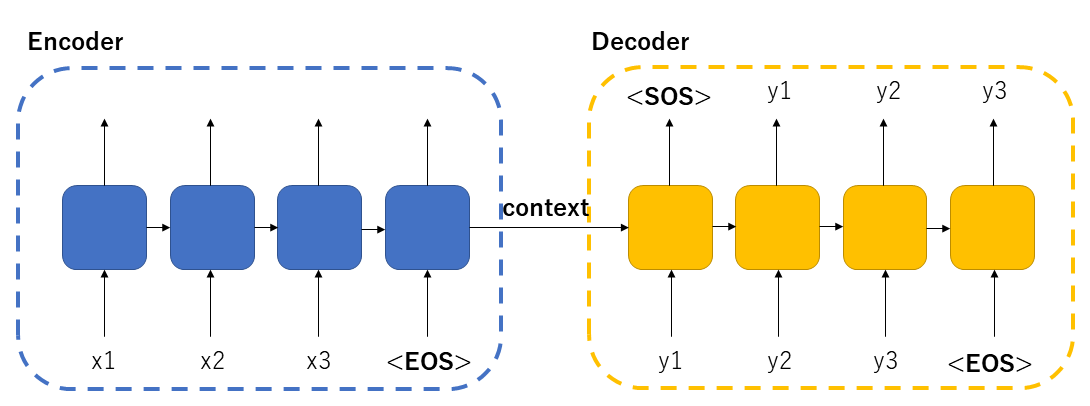
Seq2Seq models belong to theEncoder-Decoderarchitecture:
- Encoder: encodes the input sequence into a fixed-length context vector
- Decoder: generates the output sequence step by step based on the context vector
Typical Characteristics
- Input and output sequence lengths can be different
- Suitable for conversion tasks between multiple languages
- Capable of handling variable-length sequence data
Core Principles of Seq2Seq Models
Basic Architecture Components
Encoder
The encoder typically uses RNNs (such as LSTM or GRU) to process the input sequence, progressively compressing sequence information into hidden states, and finally generating a context vector that represents the entire input sequence.
Decoder
The decoder starts from the context vector and generates each element of the output sequence step by step until it produces the end token.
Workflow
- The encoder reads the input sequence and generates a context vector
- The decoder initializes its hidden state as the context vector
- The decoder generates output sequence elements step by step
- Stops when the end token is generated
Key Technical Improvements
- Attention Mechanism: solves the problem of information loss in long sequences
- Transformer Architecture: a Seq2Seq model entirely based on self-attention mechanisms
- Beam Search: improves decoding strategies to enhance generation quality
Examples
class Seq2Seq(nn.Module):
def __init__(self):
self.encoder = RNN(input_size, hidden_size)
self.decoder = RNN(hidden_size, output_size)
def forward(self, input_seq):
# Encoding phase
hidden = self.encoder(input_seq)
# Decoding phase
outputs = self.decoder(hidden)
return outputs
Application of Seq2Seq in Machine Translation
Characteristics of Machine Translation Tasks
- Both input and output are text sequences
- Sequence lengths between two languages usually do not correspond
- Requires understanding the source language and generating the target language
Typical Application Cases
- Google Neural Machine Translation (GNMT) system
- Facebook's Fairseq translation system
- Open-source tool OpenNMT
Implementation Key Points
- Use bidirectional RNN encoders to capture contextual information
- Incorporate attention mechanisms to handle long sentences
- Use subword tokenization to handle rare words
Examples
translation_model = Seq2Seq(
encoder=BiLSTM(vocab_size=src_vocab_size),
decoder=LSTM(vocab_size=tgt_vocab_size),
attention=DotProductAttention()
)
Application of Seq2Seq in Text Summarization
Classification of Text Summarization Tasks
| Summary Type | Characteristics | Seq2Seq Suitability |
|---|---|---|
| Extractive Summarization | Selects important sentences from the original text | Not suitable |
| Abstractive Summarization | Generates new condensed text | Very suitable |
Key Technical Challenges
- Handling information compression of long documents
- Maintaining coherence and accuracy of summaries
- Avoiding repeated generation of identical content
Solutions
- Pointer-Generator Network: combines extractive and generative methods
- Coverage Mechanism: tracks generated content to avoid repetition
- Reinforcement Learning: optimizes summarization metrics such as ROUGE
Examples
summarizer = Seq2Seq(
encoder=TransformerEncoder(),
decoder=TransformerDecoder(),
pointer_network=True
)
Application of Seq2Seq in Dialogue Generation
Comparison of Dialogue System Types
| Type | Characteristics | Seq2Seq Suitability |
|---|---|---|
| Task-oriented Dialogue | Completes specific tasks | Limited suitability |
| Chit-chat Dialogue | Open-domain communication | Very suitable |
Special Characteristics of Dialogue Generation
- Need to maintain dialogue coherence
- Responses should fit the dialogue context
- Avoid generating generic, meaningless responses
Improvement Methods
- Personalized Embedding: incorporates speaker characteristics
- Sentiment Control: generates responses with specific emotional tones
- Adversarial Training: improves the naturalness of responses
Examples
chatbot = Seq2Seq(
encoder=GRU(hidden_size=512),
decoder=GRU(hidden_size=512),
personality_embedding=True
)
Training and Optimization of Seq2Seq Models
Training Process
- Prepare parallel corpus datasets
- Define the loss function (usually cross-entropy)
- Train using Teacher Forcing
- Tune hyperparameters using the validation set
Common Problems and Solutions
| Problem | Cause | Solution |
|---|---|---|
| Gradient Vanishing | Long sequence dependencies | Use LSTM/GRU, or Transformer |
| Exposure Bias | Mismatch between training and testing | Scheduled Sampling |
| Generic Responses | Maximum likelihood bias | Adversarial training or reinforcement learning |
Evaluation Metrics
- BLEU: commonly used metrics for machine translation
- ROUGE: commonly used metrics for text summarization
- Human Evaluation: an important supplement for dialogue systems
Summary and Outlook
As a core technology in the NLP field, Seq2Seq models have evolved from the initial simple RNN architecture to today's powerful Transformer models. They have demonstrated strong capabilities in tasks such as machine translation, text summarization, and dialogue generation. Future development directions include:
- More efficient long-sequence processing
- Few-shot/zero-shot learning capabilities
- Multimodal sequence conversion
- More controllable content generation
By understanding the principles and applications of Seq2Seq models, you have mastered a powerful tool in NLP and can start building your own sequence conversion applications!
Other Extensions