Python NLP Ecosystem
Natural Language Processing (NLP) is an important branch of artificial intelligence. With its rich library ecosystem, Python has become the preferred language for NLP development.
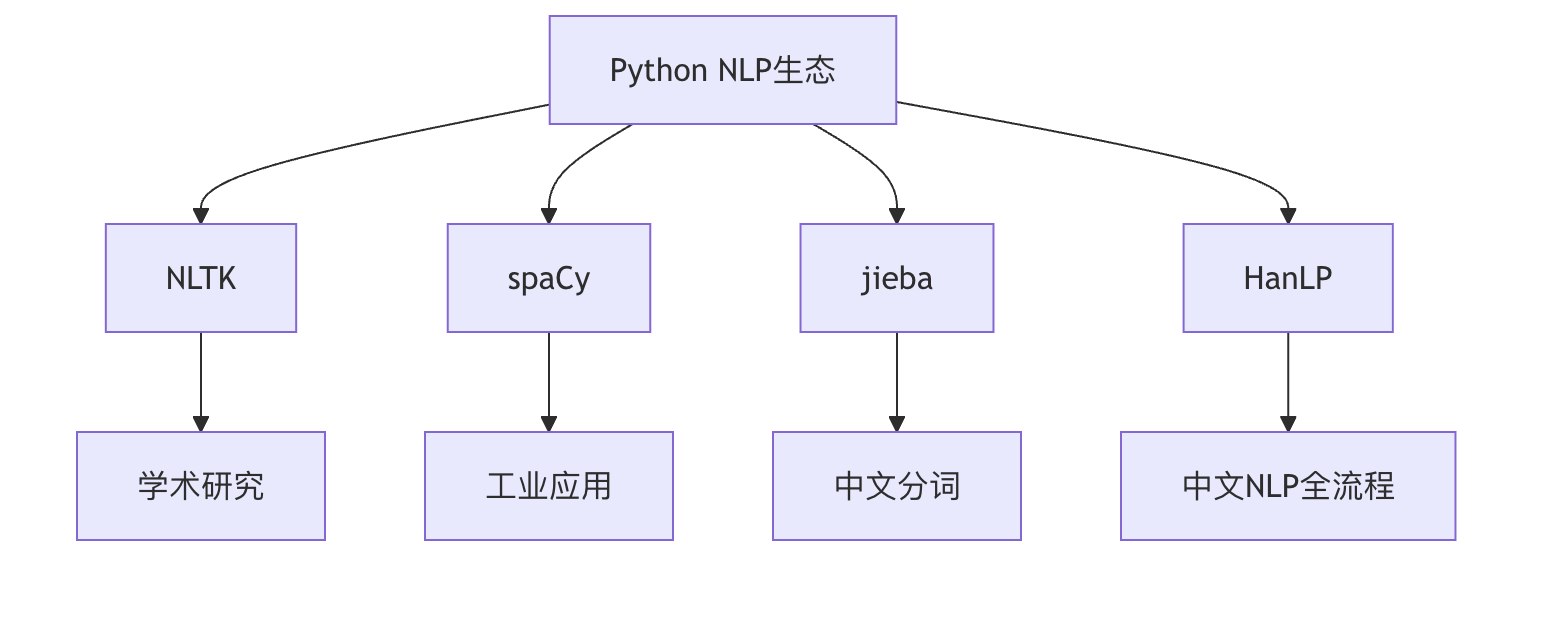
This article provides a comprehensive introduction to the core toolkits in the Python NLP ecosystem, including:
- NLTK- The preferred natural language processing toolkit for academic research
- spaCy- An industrial-grade efficient NLP framework
- jieba- The most popular Chinese word segmentation tool
- HanLP- A fully-featured Chinese NLP processing library
NLTK: The Swiss Army Knife of Natural Language Processing
Basic Introduction
NLTK (Natural Language Toolkit) is one of the most well-known Python NLP libraries. Developed by the University of Pennsylvania, it is especially suitable for teaching and research purposes.
Core Features
- Text Tokenization
- Part-of-Speech Tagging (POS Tagging)
- Named Entity Recognition (NER)
- Sentiment Analysis
- Stemming and Lemmatization
Installation and Basic Usage
Example
nltk.download('punkt') # Download the necessary data packages
# Example: Text tokenization
from nltk.tokenize import word_tokenize
text = "Natural language processing is fascinating."
tokens = word_tokenize(text)
print(tokens) # Output: ['Natural', 'language', 'processing', 'is', 'fascinating', '.']
Pros and Cons Analysis
| Advantages | Disadvantages |
|---|---|
| Comprehensive functionality covering major NLP tasks | Lower execution efficiency |
| Well-documented with abundant learning resources | Requires downloading additional data packages |
| Suitable for teaching and research | Limited support for Chinese |
spaCy: Industrial-Grade NLP Framework
Basic Introduction
spaCy is a modern NLP library focused on industrial applications, renowned for its efficiency and ease of use.
Core Features
- Pretrained model support
- Pipeline-based processing mechanism
- High-performance neural network implementation
- Multilingual support (including Chinese)
Installation and Basic Usage
Example
# Install Chinese model: python -m spacy download zh_core_web_sm
import spacy
# Load English model
nlp = spacy.load("en_core_web_sm")
doc = nlp("Apple is looking at buying U.K. startup for $1 billion")
# Extract named entities
for ent in doc.ents:
print(ent.text, ent.label_)
# Output: Apple ORG
# U.K. GPE
# $1 billion MONEY
Performance Comparison
Example
title NLP Library Processing Speed Comparison (words/second)
x-axis Library
y-axis Speed
bar NLTK: 10,000
bar spaCy: 100,000
jieba: A Powerful Tool for Chinese Word Segmentation
Basic Introduction
jieba is a word segmentation tool specifically designed for Chinese, renowned for its ease of use, efficiency, and accuracy.
Three Word Segmentation Modes
- Precise Mode: The most accurate segmentation result
- Full Mode: Scans all possible word formations
- Search Engine Mode: Further segments long words
Basic Usage Examples
Example
# Precise mode tokenization
seg_list = jieba.cut("I love natural language processing", cut_all=False)
print("Precise mode: " + "/".join(seg_list))
# Output: Precise Mode: I/love/natural language/processing
# Add custom dictionary
jieba.load_userdict("userdict.txt") # Custom dictionary file
Advanced Features
- Keyword Extraction
- Part-of-Speech Tagging
- Parallel word segmentation (improves processing speed for large texts)
HanLP: One-Stop Chinese NLP Solution
Basic Introduction
HanLP is an NLP toolkit consisting of a series of models and algorithms, with the goal of promoting the application of natural language processing in production environments.
Features and Characteristics
- Supports multiple word segmentation modes
- Named Entity Recognition
- Dependency Parsing
- Text Classification
- Sentiment Analysis
Basic Usage Examples
Example
# Word segmentation example
print(HanLP.segment('Hello, welcome to HanLP!'))
# Output: [hello/vl, ,/w, welcome/v, use/v, HanLP/nx, !/w]
# Dependency parsing
sentence = HanLP.parseDependency("I love natural language processing")
print(sentence)
Multilingual Support
HanLP supports not only Chinese but also:
- English
- Japanese
- Korean
- and many other languages
Tool Selection Guide
Application Scenario Comparison
| Tool | Best-fit Use Cases | Chinese Support | Learning Curve |
|---|---|---|---|
| NLTK | Academic research, teaching | Limited | Moderate |
| spaCy | Industrial applications, production environments | Good | Gentle |
| jieba | Chinese word segmentation tasks | Excellent | Simple |
| HanLP | Complex Chinese NLP tasks | Excellent | Steeper |
Performance Considerations
- Processing Speed:spaCy > jieba > HanLP > NLTK
- Memory Usage:HanLP > spaCy > NLTK > jieba
- Accuracy(Chinese): HanLP ≈ jieba > spaCy > NLTK
Comprehensive Practical Case: Chinese Text Analysis Pipeline
Example
import jieba
from hanlp import HanLP
import spacy
text = "Natural language processing is an important branch of artificial intelligence, and has developed rapidly in recent years."
# 1. Use jieba for word segmentation
words = list(jieba.cut(text))
print("tokenization result:", words)
# 2. Use HanLP for part-of-speech tagging
print("\nPart-of-speech tagging:")
print(HanLP.segment(text))
# 3. Use spaCy's English model to process the English part
nlp = spacy.load("en_core_web_sm")
doc = nlp("Natural Language Processing is amazing.")
print("\nEnglish entity recognition:")
for ent in doc.ents:
print(ent.text, ent.label_)
Recommended Learning Resources
Official Documentation
- NLTK: https://www.nltk.org/
- spaCy: https://spacy.io/
- jieba: https://github.com/fxsjy/jieba
- HanLP: https://hanlp.hankcs.com/
Summary and Outlook
The Python NLP ecosystem provides a complete toolchain spanning from academic research to industrial applications. For Chinese text processing, jieba and HanLP are indispensable tools, while spaCy excels in multilingual support and industrial deployment. Future NLP development will place greater emphasis on:
- Application of pretrained language models (such as BERT, GPT)
- Multimodal processing capabilities
- Support for low-resource languages
- Interpretability and fairness