Linux Introduction
The Linux kernel was originally written by Finn Linus Torvalds as a personal hobby while he was studying at the University of Helsinki.
Linux is a free-to-use and freely distributed Unix-like operating system. It is a multi-user, multi-tasking operating system based on POSIX and UNIX that supports multi-threading and multiple CPUs.
Linux can run major UNIX utility software, applications, and network protocols. It supports 32-bit and 64-bit hardware. Linux inherits Unix's network-centric design philosophy and is a stable multi-user network operating system.
Linux Distributions
Simply put, a Linux distribution is a packaging of the Linux kernel with application software.
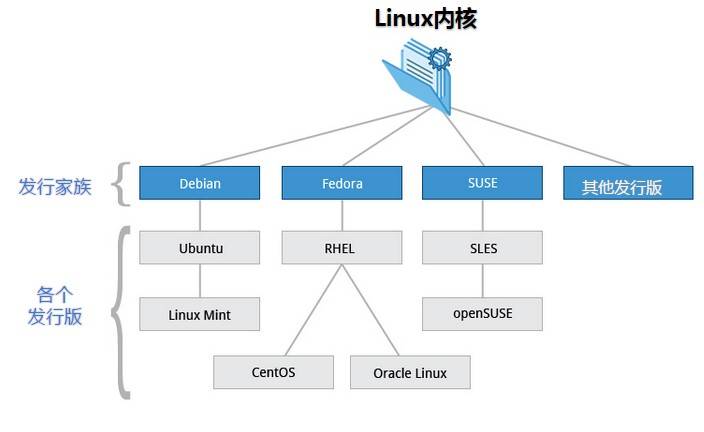
Currently, the more well-known distributions on the market include: Ubuntu, RedHat, CentOS, Debian, Fedora, SuSE, OpenSUSE, Arch Linux, SolusOS, etc.
Linux Application Fields
Today, various Linux distributions are used in many different contexts, from embedded devices to supercomputers, and have established a position in the server field. Servers typically use the LAMP (Linux + Apache + MySQL + PHP) or LNMP (Linux + Nginx + MySQL + PHP) stack.
Currently, Linux is not only used in homes and enterprises, but is also very popular in government.
- The Brazilian federal government is world-famous for supporting Linux.
- There are news reports that the Russian military has developed its own Linux distribution, and as the G.H.ost project it has achieved results.
- The Indian state of Kerala plans to promote the use of Linux in all high schools across the state.
- The People's Republic of China, in order to achieve technological independence, exclusively uses Linux on its Loongson processors.
- Some regions in Spain have developed their own Linux distributions, widely used in government and education, such as gnuLinEx in Extremadura and Guadalinex in Andalusia.
- Portugal developed its own Linux distribution, Caixa Mágica, and applied it to Magalhães educational laptops and the government's e-escola education program.
- France and Germany have also begun to gradually adopt Linux.
Linux vs Windows
Currently, in China, Linux is more often used on servers, while Windows is more commonly used as the desktop operating system. The main differences are as follows.
| Comparison | Windows | Linux |
|---|---|---|
| Interface | Unified interface, fixed shell; menus of all Windows programs are almost identical, and shortcut keys are almost the same. | The graphical interface style varies by distribution and may be incompatible with each other. GNU/Linux terminals are inherited from UNIX, and the basic commands and operation methods are also almost the same. |
| Drivers | Rich drivers with frequent version updates. The default installer generally includes drivers for hardware that was popular at the time of that version's release; drivers for newer hardware released later depend on hardware manufacturers. For some older hardware, if the original drivers are gone, it can sometimes be difficult to support. In addition, sometimes hardware manufacturers do not provide the required version of Windows drivers, which can also be troublesome. | Developed by volunteers and released by the Linux core development team. Many hardware manufacturers do not provide drivers due to copyright considerations. Although most drivers do not require manual installation, when installation is involved it is relatively complex, leaving new users at a loss when facing driver issues (whether they exist and how to install them). However, under the open-source development model, drivers for many older hardware devices that are difficult to support even under Windows can be easily found. Hardware manufacturers such as HP, Intel, and AMD are gradually supporting open-source drivers to varying degrees, and the problem is being alleviated. |
| Usage | It is relatively simple to use and easy to get started. The graphical interface is very beneficial for users without a computer background. | The graphical interface is easy to use and easy to learn. The text interface requires study to master. |
| Learning | The system structure is complex and changes frequently, knowledge and skills become obsolete quickly, and in-depth learning is difficult. | The system structure is simple and stable, knowledge and skills are well passed down, and in-depth learning is relatively easy. |
| Software | Every specific function may require commercial software support, and you need to purchase the corresponding license. | Most software can be freely obtained, but there are fewer choices for software with the same functionality. |