XLink and XPointerIntroduction
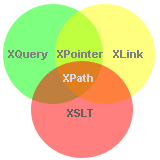
XLink defines a standard way to create hyperlinks in XML documents.
XPointer allows hyperlinks to point to more specific parts (fragments) of XML documents.
Prerequisites
Before you begin this tutorial, you should have a basic understanding of:
- HTML / XHTML
- XML / XML Namespaces
- XPath
If you want to learn these topics first, please visit these tutorials on our homepage.Homepage.
What is XLink?
 |
|
What is XPointer?
|
|
XLink and XPointer are W3C Standards
On June 27, 2001, XLink was established as a W3C Recommendation.
XPointer became a W3C Recommendation on March 25, 2003.
In ourW3C Tutorial, you can read more about XML standards.
Browser Support for XLink and XPointer
Browsers support XLink and XPointer only to a minimal extent.
Mozilla 0.98+, Netscape 6.02+, and Internet Explorer 6.0 all have some degree of support for XLink. Earlier versions of browsers do not support XLink at all.
Other extensions