UniApp Introduction
UniApp is a cross-platform development framework based on Vue.js, developed and maintained by DCloud.
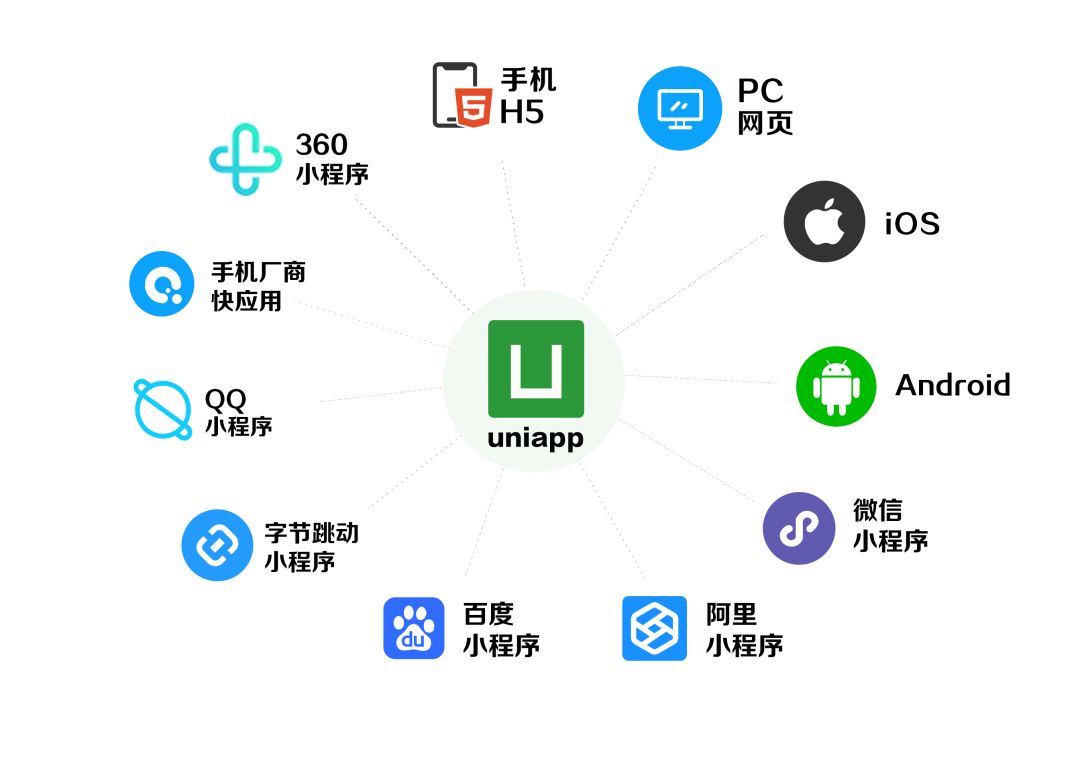
UniApp's core goal is to achieve "develop once, publish to multiple platforms," that is, using one set of code to publish to multiple platforms at the same time.
UniApp is a framework well suited for rapid development of cross-platform applications, especially for projects that need to cover mini-programs, H5, and Apps.
UniApp has a low learning cost and high development efficiency, while also having strong community support and a rich plugin ecosystem.
UniApp Application Scenarios
WeChat Mini Program Development: Rapidly develop and publish to the WeChat Mini Program platform.
H5 Web Development: Build web applications adapted for mobile devices.
Cross-platform App Development: Develop Android and iOS applications without needing to learn native development separately.
Multi-platform Unified Projects: Projects that need to cover mini-programs, H5, and Apps simultaneously.
UniApp Features and Advantages
1. Cross-platform capability
-
One set of code can be compiled to multiple platforms, reducing duplicate development costs.
-
Supports conditional compilation, making it easy to handle differences between platforms.
2. Based on Vue.js
-
Uses Vue.js syntax, with a low learning cost, suitable for front-end developers to get started quickly.
-
Supports Vue.js's component-based development model.
3. High performance
-
Based on native rendering, with performance close to native applications.
-
Supports native plugin extensions to meet high-performance requirements.
4. Rich components and APIs
-
Provides a large number of built-in components (such as
view、text、imageetc.) and APIs (such as network requests, data caching, device information, etc.). -
Supports the use of native plugins and third-party SDKs.
5. Development tool support
-
Officially recommended to useHBuilderXIDE, providing an integrated development experience such as code hints, debugging, packaging, etc.
-
Supports hot updates, with high development efficiency.
6. Active community and ecosystem
-
Has a large developer community and a rich plugin marketplace.
-
Official documentation is detailed, with abundant learning resources.
UniApp Core Technologies
Vue.js: UniApp is developed based on Vue.js and supports Vue.js syntax and features (such as data binding, componentization, lifecycle, etc.).
Conditional compilation: Through
#ifdefand#ifndefAchieve code adaptation for different platforms.Native rendering: On the App side, UniApp uses native rendering technology, with performance close to native applications.
Plugin mechanism: Supports extending functionality through native plugins and third-party plugins.
UniApp Limitations
Performance issues: In complex App scenarios, performance may not be as good as pure native development.
Platform differences: APIs and behaviors of different platforms may differ, requiring additional handling of compatibility issues.
Learning curve: Although based on Vue.js, cross-platform development still requires understanding techniques for multi-platform adaptation.
UniApp Comparison with Other Frameworks
| Comparison item | uni-app | React Native | Flutter | Taro |
|---|---|---|---|---|
| Tech stack | Vue.js | React | Dart | React |
| Supported platforms | 10+ | iOS/Android/Web | iOS/Android/Web | Mini-program/H5/RN |
| Learning cost | Low | Medium | High | Medium |
| Performance | Excellent | Excellent | Excellent | Good |
| Ecosystem | Rich | Mature | Rapidly developing | Fairly good |
| Mini-program support | Native support | Needs conversion | Needs conversion | Native support |
UniApp Open Source Information
GitHub repository:https://github.com/dcloudio/uni-app
Open source license:Apache License 2.0
Open source content: The core framework and some tools are open source, and developers can freely view, modify, and contribute code.