Scala break Statement
 Scala Loops
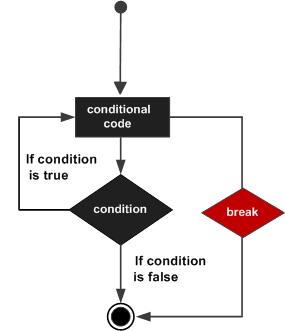
There is no break statement in Scala by default, but you can use another way to implement it after Scala 2.8.breakstatement. When used in a loop,breakstatement, when it is executed, the loop will be interrupted and the code block after the loop body will be executed.
Syntax
The syntax of break in Scala is a bit different, the format is as follows:
// 导入以下包
import scala.util.control._

// 创建 Breaks 对象
val loop = new Breaks;

// 在 breakable 中循环
loop.breakable{
    // 循环
    for(...){
       ....
       // 循环中断
       loop.break;
   }
}
Flowchart
Example
import scala.util.control._

object Test {
   def main(args: Array[String]) {
      var a = 0;
      val numList = List(1,2,3,4,5,6,7,8,9,10);

      val loop = new Breaks;
      loop.breakable {
         for( a <- numList){
            println( "Value of a: " + a );
            if( a == 4 ){
               loop.break;
            }
         }
      }
      println( "After the loop" );
   }
}
The output of executing the above code is:
$ scalac Test.scala
$ scala Test
Value of a: 1
Value of a: 2
Value of a: 3
Value of a: 4
After the loop
Breaking Nested Loops
The following example demonstrates how to break nested loops:
import scala.util.control._

object Test {
   def main(args: Array[String]) {
      var a = 0;
      var b = 0;
      val numList1 = List(1,2,3,4,5);
      val numList2 = List(11,12,13);

      val outer = new Breaks;
      val inner = new Breaks;

      outer.breakable {
         for( a <- numList1){
            println( "Value of a: " + a );
            inner.breakable {
               for( b <- numList2){
                  println( "Value of b: " + b );
                  if( b == 12 ){
                     inner.break;
                  }
               }
            } // 内嵌循环中断
         }
      } // 外部循环中断
   }
}
The output of executing the above code is:
$ scalac Test.scala $ scala Test Value of a: 1 Value of b: 11 Value of b: 12 Value of a: 2 Value of b: 11 Value of b: 12 Value of a: 3 Value of b: 11 Value of b: 12 Value of a: 4 Value of b: 11 Value of b: 12 Value of a: 5 Value of b: 11 Value of b: 12Other Extensions