When people think of choosing a computer language, they may choose one of the well-known general-purpose procedural languages learned in school, such as C, Java, or Python. But these frequently chosen languages are only the tip of the iceberg in the field of computer languages – if it uses keywords and structures to convey information, then it is a language. Below are the ten cloud computing languages worth considering.
1. SQL Data Language
When it comes to data languages, SQL has been the undisputed overlord for decades. Even non-relational database servers use some form of SQL language. Just like every other area of IT, the cloud computing field is likewise full of SQL.
This is an SQL joke that developers everywhere will smile at. "A man walks into a bar, sees two tables, and says, 'Can I join you?'"
2. XML Data Language
XML is used to describe documents, not to convey a series of instructions. Because XML usually does not issue instructions to the computer, it is generally not considered a computer language.
XML is a hugely popular data markup language, and this is mainly attributed to Java. Wherever there is Java, there is XML. And because Java has been driving large-scale distributed systems long before cloud computing became popular, XML documents are everywhere. Apache Hadoop configurations reside in XML files.
3. R Mathematical Language

The R language helps a wide range of developers handle statistics, reports, and graphics. Interactive R tutorials allow new developers to appreciate the fun of vectors, factors, and associated datasets.
Amazon bundles the RStudio integrated development environment (IDE) with its EMR (Elastic MapReduce) service to help with big data analysis.
4. Clojure Mathematical Language

Clojure is not just a mathematical language; it is both a general-purpose language and a functional language. Also, as it happens, Clojure is very popular among data analysts.
The real-time data stream processing system Apache Storm is written in Clojure. Functional languages do not require semicolons, while procedural languages do; you can see that semicolons are only used for comments in this Clojure script (https://github.com/apache/storm/blob/master/storm-core/src/clj/backtype/storm/clojure.clj).
5. Haskell Functional Language
Haskell is a functional language that is ideally suited for distributed computing. The Cloud Haskell platform project was launched several years ago.
Despite Haskell's fairly high adoption rate in the industry, and its place in the top 20 languages on GitHub, its adoption in cloud computing has been lackluster – possibly because Haskell is considered too hard to learn. You can experience it yourself in the Try Haskell tutorial.
6. Erlang Functional Language

Erlang was born out of Ericsson. In the telecommunications industry, products must run forever, and everything (customers, contacts, transactions, and records) is counted in the millions.
A carrier-grade functional language sounds perfect for cloud computing. In fact, although it hasn't made the top 20 languages on GitHub, Erlang drives popular cloud computing applications, including Riak, CouchDB, RabbitMQ, and even LING single-kernel.
7. Python Procedural Language
Python is a high-level language designed to be easy to read. These days, almost everyone – indeed everyone – can get started with Python quickly. Learning aids include courses, books, and even interactive Python tutorials.
OpenStack is a popular infrastructure-as-a-service (IaaS) management software, and it is written in Python. Take a look at this Python code for the Nova client interface (https://github.com/openstack/python-novaclient/blob/master/novaclient/client.py).
8. Go Procedural Language

A few years ago, Google developed Go, when some of its programmers were rather frustrated with languages like Stroustrup's C++. Google provides an interactive Go tutorial and the Go Playground for working with code.
As a darling of the cloud computing field, Docker is written in Go, as are many other projects in the Docker ecosystem.
9. GFM Domain-Specific Language
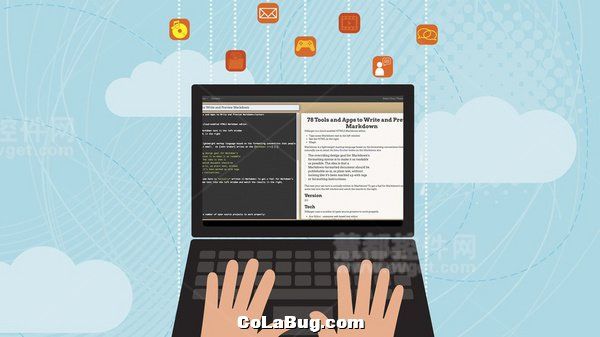
GFM (GitHub Flavored Markdown) is a plain-text formatting language that can be used to document software repositories on GitHub. GFM is used by millions of developers because millions of developers use GitHub.
Since there are so many cloud-specific projects on GitHub, such as Cloud Foundry, it's good to know GFM. It may be the easiest of the ten languages introduced in this article to learn.
10. Regular Expression Domain-Specific Language
Regex syntax makes novices scratch their heads, because it is really symbolic – only single characters, not keywords. Regex code looks like someone fell asleep on the keyboard. If you want to be put off regex for life, take a look at this extreme example: JSON parser (http://www.perlmonks.org/?node_id=995856).
However, regular expressions are a cornerstone of the Linux world. One of the core principles of the old UNIX operating system and its Linux derivatives is the extensive use of text. Text is used everywhere, for configuration, on the command line, and in protocols. Regular expressions help developers manage text well.
There are also hundreds of other languages
There are many more excellent languages to choose from. Take some time to read a book like the classic 2010 book Seven Languages in Seven Weeks (https://pragprog.com/book/btlang/seven-languages-in-seven-weeks), which gives you a general understanding of several languages, including Prolog and Scala. Or, you can choose your own combination of languages.
Source: http://www.evget.com/article/2015/3/27/22249.html