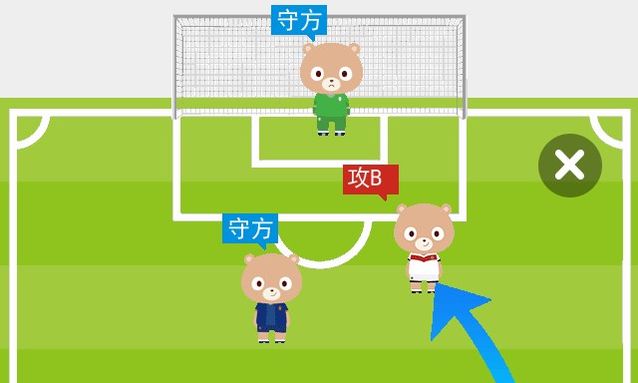
The World Cup brings the whole world into match-watching mode, and large numbers of "fake fans" emerge. How to tell whether a fan is a fake fan? If you don't know what "offside", a word constantly on commentators' lips, means, you can basically be counted as a fake fan. This rule, which has a profound impact on modern football, is very complex to describe; text and images are both difficult to explain clearly, and ordinary people really find it hard to understand. Mobile Baidu's mobile search detected that searches for "offside" were soaring, and made a new feature: users only need to search "offside" on Mobile Baidu, and an illustrative animation will pop up directly, letting users understand what offside actually is more visually and intuitively, no longer afraid of being exposed as fake fans.
"Special search" liberates fake fans, foolproof search
This kind of special search with animated display is nothing new. During Christmas 2011, searching for Christmas on Baidu PC would show Santa-related animations, but such "Easter eggs" previously existed mainly on PC, and mostly as fun during holidays, not linked to user needs to solve user problems.
Mobile Baidu's "offside" special search is the first to combine search results with animated effects. It brings mobile search into foolproof mode: no selection, no clicking, just search and see the result.
This Mobile Baidu special search is determined by the characteristics of this World Cup. The match times of this World Cup are mostly in the middle of the night or early morning, and third-party live streaming is not supported, so people mostly watch the games on TV and use their phones to search for related content. Mobile Baidu has over 500 million users, its monthly active users exceeded 100 million a year ago, and it holds nearly 80% of China's mobile search market share. Mobile Baidu's "offside" special search is undoubtedly a popularization of football knowledge.
Special search has high requirements for search result accuracy
The animated special search launched this time by Mobile Baidu is very worth learning from for mobile search - Google does not have such a function. The most primitive mobile search results were text + hyperlinks; later, direct search results began to appear. Users can fill in forms on the search results page, play games, check the weather, use a calculator, and more. Baidu's box computing has taken direct search to the fullest.
Direct search is very important in mobile search. After searching on PC, users can click multiple search results to choose the most suitable one, but on mobile, limited screen size and network speed restrictions make every click more costly. At this point, accurately finding search results becomes very important.
If a search engine can ensure that the few results displayed on the first screen are what users need, that's already remarkable; if it can directly pop up a special result, it means the search engine is 100% certain it has understood the user's needs. This can only be achieved when there is sufficiently strong user intent understanding and the ability to provide the information and services users need.
Mobile Baidu continuously upgrades interaction modes to seize the mobile search market
After Baidu entered the mobile era, it did several things in mobile search:
1. Optimize input methods:To make it easier for users to submit search requests, Mobile Baidu developed leading voice recognition, LBS, and image search technologies, and spawned star applications such as Baidu Mitu.
2. Optimize output results:To make it easier to display search results to mobile users, Baidu uses transcoding technology to adapt PC webpages to mobile, uses the Light App platform to turn webpages into light apps more suitable for mobile users, and uses card-style applications to provide result formats more suitable for phones. This time, "special search" goes a step further by introducing direct animated results. In the future, it may extend to voice, image, and other multimedia output methods. For example, if a user searches for "Transformers 4 trailer", Mobile Baidu will directly enter playback mode, reducing user clicks.
3. Optimize advertising technology:Use big data technology to improve the precision of ad targeting while reducing the amount of on-page ads, finding a balance between mobile user experience and commercial demands.
4. Provide accurate content:Optimize search channels, for example, strengthen Tieba, novels, and URL channels, weaken music channels, and provide vertical apps such as Baidu Video, Baidu Maps, and Baidu Tieba, giving users more accurate results.
Mobile Baidu's mobile search has spared no effort in optimizing input/output interactions to adapt to mobile search scenarios completely different from PC search, gradually transitioning from connecting information to connecting information and services. The shift from connecting people with information to efficiently connecting people with services is something Mobile Baidu must also do. People's searches on mobile are no longer just to find information and answers, but to seek services and solve real-life needs. To achieve this, it is necessary to do search interaction, intent understanding, and result matching with new thinking. Mobile Baidu's "offside" special search reflects this shift, and will inevitably be imitated by other mobile search engines.
Article source: Everyone is a Product Manager