As is well known, Microsoft’s naming rules for Windows have always been strange, from XP, Vista, 7 to 8 and 8.1, all the way to the latest Windows 10. So from a technical perspective, why did Microsoft skip 9 and use 10 directly? According to rumors from Microsoft internal developers, it was for the version numbers of previous operating systems.
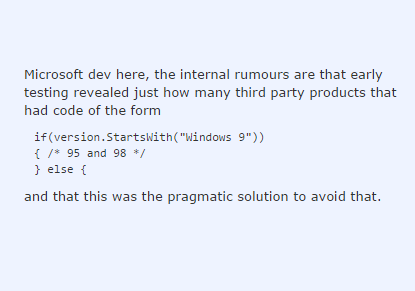

Example code is as follows
if ( version.StartsWith(“Windows 9″) )

{ /*Windows 95, Windows 98 */

} else{

}
When software developers use: "If the version number starts with xxx, then execute yyy", there are two cases where the condition evaluates to true.
Windows 9
Windows 9* ( Windows 95 Windows 98 ) 95 and 98 also begin with "Windows 9".
In summary, during early testing, Microsoft found that many third-party software developers used the above method to judge the operating system, which would cause programs running the above code on Windows 95 and Windows 98 to be misjudged as Windows 9.
So, to avoid this unstable factor, Microsoft developers had no choice but to name it Windows 10.