Develop with Claude Code, Codex CLI, and OpenCode — these tools all run in the terminal.
Many people install them and start using them right away, still using macOS's built-in Terminal.app or Windows' cmd. They run fine, but when you open four or five panes at once — one running Claude Code, one running a dev server, one watching logs, one running tests — the system default terminal can't handle it, and lag is obvious when AI outputs large chunks of content.
The terminal is one of the tools you have open the longest every day, so it's worth picking one carefully~
Before choosing, understand these key dimensions:
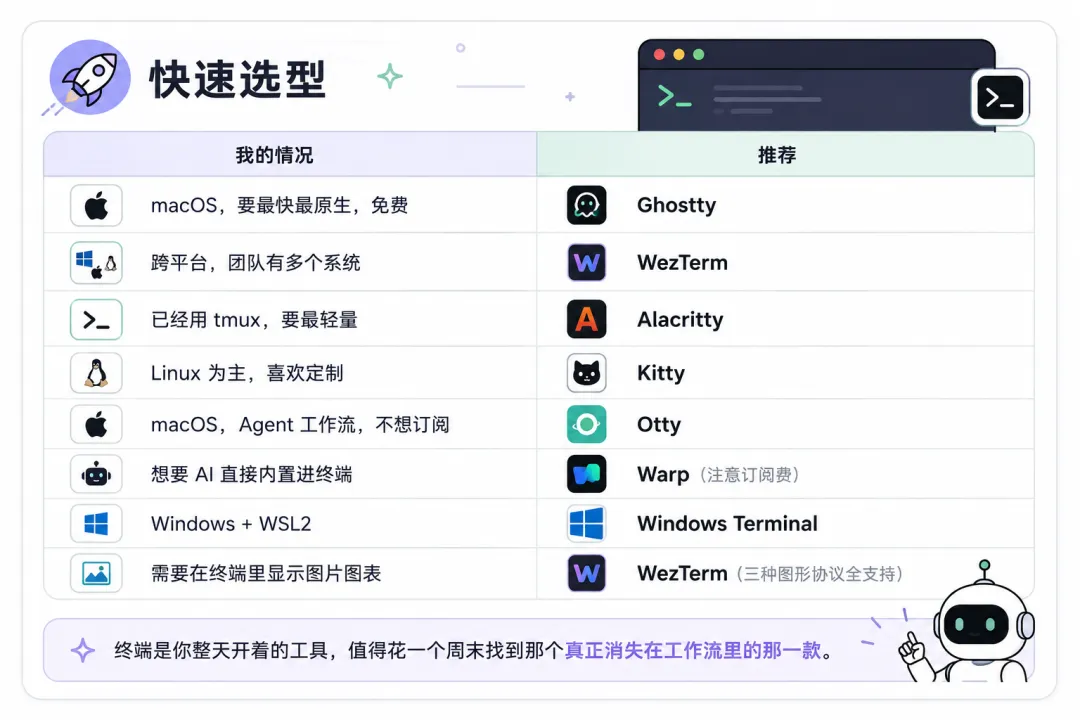
GPU Rendering — When Claude Code streams out hundreds of lines of code or logs scroll rapidly, CPU rendering stutters, GPU rendering doesn't. It's basically standard on modern terminals.
Graphics Protocols — AI tools increasingly output images, charts, and rendered diffs, requiring the terminal to support Kitty / Sixel / iTerm2 protocols for proper display.
Configuration as Code — Config files can be managed with Git, letting you restore your environment in one second on a new computer and keep multiple machines consistent.
Built-in AI — The terminal has built-in AI command suggestions and error explanations (deepest in Warp), or connects via shell plugins like gh copilot, Amazon Q, aichat.
Multiplexing — Manage multiple panes and sessions simultaneously. WezTerm has it built-in; other terminals pair with zellij (recommended for beginners) or tmux.
Ligature Font Support — With programming fonts like Fira Code and JetBrains Mono, != displays as ≠, improving code readability.