Computers have become an important tool in our work. While white-collar workers enjoy the convenience computers bring to their jobs, they often suffer from "computer disease". After long hours of using a computer, when your body is no longer as agile as Lara in Tomb Raider, it is time to pay attention to your health. If your movements have become as mechanical as a Gundam warrior, you really should take care of yourself. If you have already turned into a "sunflower", only moving your head with the flicker of the computer screen, "computer plant person" is your latest alias. Please stop immediately, stand up and move around, otherwise when you become a "mineral", there is really no saving you.
Let me first tell you about the part of the body that is most obviously affected by long-term computer use—the shoulders and neck. In traditional Chinese medicine, the shoulders and neck govern the flow of qi in the human body. Without qi, life is lost. They can be called the stewards of human lifespan: when they are clear, everything is clear; when they are blocked, a hundred diseases arise. According to statistics, more than half of office workers have shoulder and neck pain. As for when the pain occurs, 80% of people will gradually feel pain in the afternoon or evening. This shows that most people develop chronic pain due to occupational injuries or incorrect posture, after accumulating a day's stress and fatigue, so it surfaces near evening. In severe cases, it not only affects work, but even the stabbing pain at night makes people toss and turn and find it hard to fall asleep.
Long-term shoulder and neck strain can show up on the face and in mental and physical ways, such as a dull yellowish complexion, spots, blackheads, dry skin, as well as headaches, migraines, forgetfulness, insomnia, hair loss. At the same time, it can easily cause rhinitis, pharyngitis, respiratory diseases, frozen shoulder, shoulder pain, numbness in the upper limbs, and various other symptoms.
If you don't want to become a computer plant person, quickly learn the shoulder and neck care exercises from me.
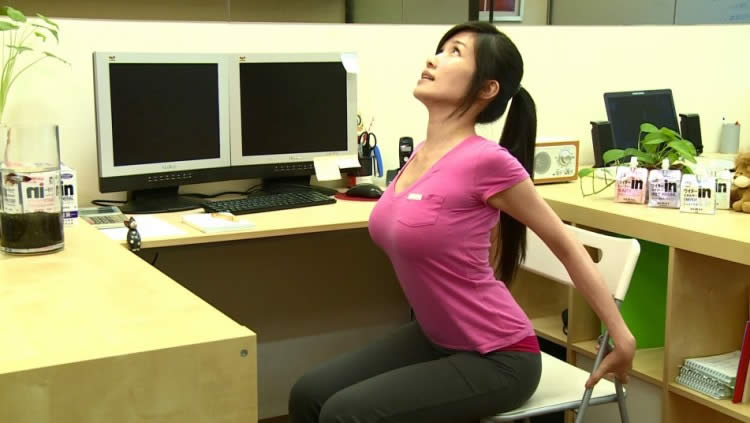
First, when using a computer, stop every 45 minutes and exercise for 3 minutes. The following care exercises can help improve shoulder and neck problems right at your desk:
1. Neck Exercises
- 1. Head forward bend: Extend the head forward and bend it down, eyes looking at the ground. Close the mouth and make the lower jaw as close to the chest as possible. Then return to the starting position. Repeat several times. The movement should be slow; do not lower your head too quickly.
- 2. Head tilt backward: Tilt the head backward, eyes looking at the sky, keeping the forehead as high as possible. Pause briefly, then return to the starting position. Repeat several times. When tilting backward, wait until you feel a slight soreness in the neck, then return.
- 3. Head left-forward extension: Extend the head and neck forward and to the left, eyes looking at a spot 2–3 meters away in the left front and lower direction. Keep the neck as stretched as possible. When you feel a stretching sensation in the neck, return to the starting position.
- 4. Head right-forward extension: Same as above, extend to the right.
- 5. Rotate the neck to the right rear upper direction: Rotate the head and neck as far as possible to the right, rear, and upper direction, eyes looking at the sky in that direction. Slightly stretch the neck upward and to the right, then return. Rotate slowly.
- 6. Rotate the neck to the left rear upper direction: Same as above, in the opposite direction.
- 7. Jaw circle: Extend the head and neck forward, then bring it back in a downward arc. This movement uses the jaw to lead the head and neck in a circular motion. Circle upward, then circle in the opposite direction, repeat several times. Then you can move the head and neck to the left or right front, using the jaw to lead the head and neck in a circular motion.
- 8. Head side bends: Bend the head from side to side, stretching the neck as fully as possible.
2. Shoulder Exercises: Use shoulder movements to drive activity around the cervical spine
- 1. Shoulder shrug: Relax the shoulders, then lift them upward together and drop them.
- 2. Shoulder shrug circles: Relax the head and neck, and use the shoulder joints as the axis to make circular shoulder movements, i.e., stretch the shoulders in a circular motion forward, upward, and backward.
3. Self-Tuina and Neck Massage
- 1. Squeeze the neck with both palms: Interlock the fingers of both hands and place them behind the head and neck. Spread both arm joints outward as much as possible, and squeeze the back of the neck with both palms several times. Then adduct both elbows as much as possible, and forcefully squeeze the left and right sides of the neck with both palms.
- 2. Lift the neck: Interlock the fingers of both hands behind the neck and forcefully pull the neck upward several times. Then support the jaw with both palms and gently push the neck upward several times.
- 3. Pinch shoulder muscles: Tilt the head to the left, and use the left hand to pinch-knead the right shoulder muscle group. Then tilt the head to the right, and use the right hand to pinch-knead the left shoulder muscle group.
- 4. Knead the back of the neck: Place one hand on the back of the neck. Separate the thumb and the other four fingers to clamp the muscles at the back of the neck, and pinch-knead the neck muscles, moving upward and downward, then knead from the bottom upward.
- 5. Rub the neck: Use the palm to massage the left and right sides of the back of the neck.
- 6. Relaxing dry face wash: Place both palms on the face, massage upward from the jaw, then over the head and down to the neck. Repeat several times.