I believe many people have had super dreams like destroying the earth and saving the world, and quite a few have declared they would destroy the internet. Amid jokes and laughter, we might wonder: can anyone actually destroy the internet? In reality, this is physically achievable.
Undoubtedly, if you truly destroyed the internet, it would become a feat of terrorism in human history, and it would also mean declaring war on countries around the world. So, treat the following content as a thought experiment.
First, let's stop thinking of the internet as something invisible and intangible. In fact, it is made up of large amounts of metal, plastic, and fiber optic cable. Its reach spans the globe, like a mechanical monster embracing the entire earth. So we search for the physical foundation of the network, traversing oceans and land, to figure out exactly what should be done.
The internet has no master switch, no self-destruct button, and is not affected by power outages. Precisely because of its excellent design and continuous exploration and improvement, the internet is almost indestructible. Take fiber optic networks: even if you cut most of the cables, the rest will still keep transmitting, able to automatically re-confirm transmission paths, ensuring smooth connections between continents or countries.
However, like everything else on earth, if it was built, then it can always be destroyed. That is to say, with enough effort, you can completely destroy the internet just like chopping down a tree, as long as you know where to start cutting.
Step 1: Cut the fiber optic cables
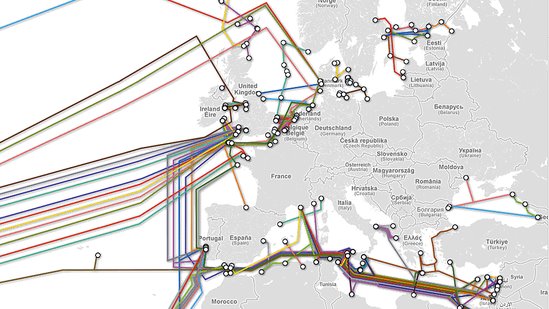
Diagram of submarine cable locations
The internet exists because of connections made by thousands of meters of thick, worn-out cables. Long submarine fiber optic cables connect continents, making the world a whole. As mentioned earlier, cable connections can support each other; when one breaks, another takes over the task. So what if they were all cut?
The internet is a network full of cables. Home computers, office equipment, and servers abroad are all connected through these cables. Cut these connections, and the network can no longer communicate across oceans. The internet would immediately fracture.
On this page you can find every major internet backbone cable in the world.
These submarine cables are sometimes disguised, or partially buried. But sometimes they are exposed on beaches like discarded surfboards. For cables buried beneath the sand, you can use a cable locator like this to find the exact location.
Although the precise locations of many cables and their landing points are not publicized, they can always be spotted on famous coastlines and in bustling towns.
If the following three cable points were destroyed, the consequences would be very serious. Destruction of one point would only cause slowdowns and disruptions, but not complete paralysis. However, sites across the ocean would become immediately unreachable, and many other websites would be too slow to use. The internet would still operate chaotically and slowly, but it would be a good start.
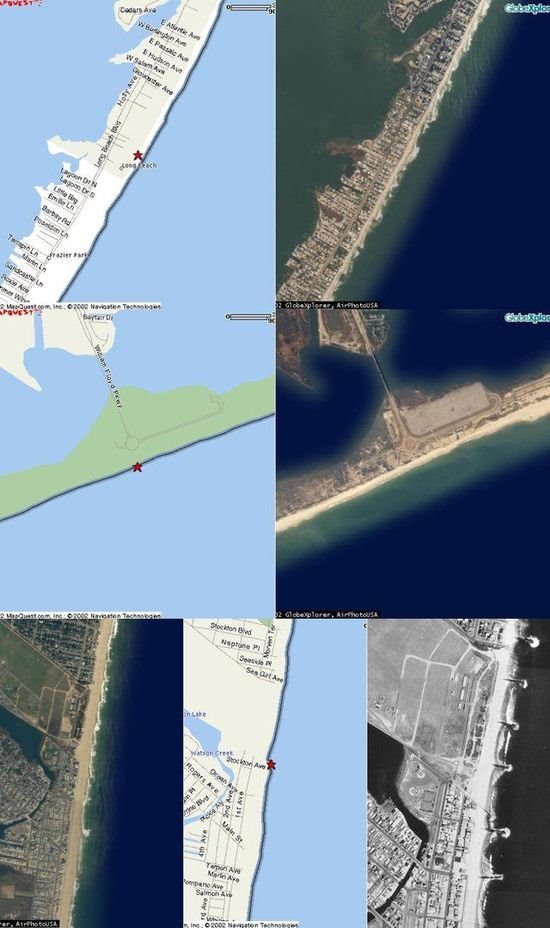
From top to bottom: Mastic Beach, Long Island; Manahawkin, New York State; and Tuckerton, New York State
These points connect the East Coast of the United States with Western Europe. They are among the world's densest and most important infrastructure points. Destroying these connections would cause the global economy to collapse.
Besides the three points above, there are other locations that could most weaken internet connectivity: Singapore / Egypt (Mediterranean and Red Sea) / Southwest England / Tokyo / Hong Kong / South Florida / Sicily / Mumbai / Chennai. Destroying facilities at these locations would mean the internet is no longer a global whole; each continent and island would be isolated.
Step 2: Destroy the root servers
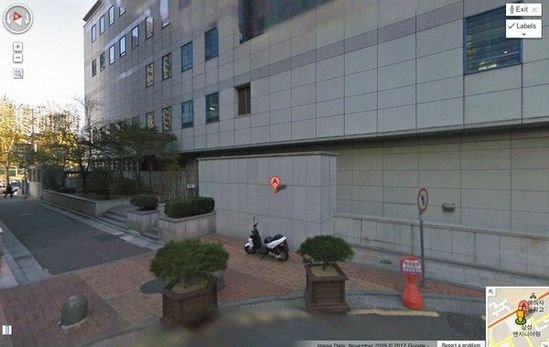
The M server is run by the WIDE Project, located in Seoul.
Domain name entry is actually the result of converting IP fields. For example, the IP address of "Google.com" is 74.125.228.37. But there are countless websites, and the difficulty of remembering IP addresses makes this conversion process indispensable.
Currently, there are 13 root domain name servers worldwide, named "A" through "M", responsible for resolving IP address domain names. If these machines were paralyzed, those wanting to go online would have to memorize numbers.
How do you find and destroy these servers? Like the cables before, these servers are also an open secret.
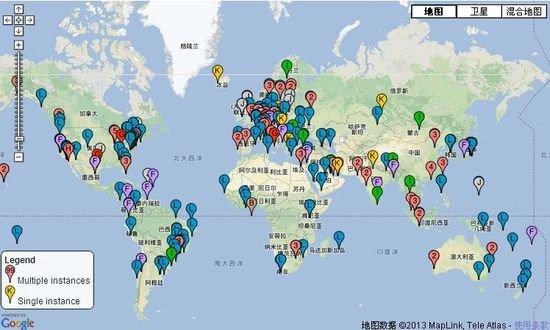
Global DNS server distribution map. Besides the 13 root domain name servers, there are many other DNS servers.
For example, say we want to destroy the "K" server, which is run by a company called RIPE NCC. Go to the company's website, and use Google Maps to find the server's location. But actually getting in would be extremely difficult; one can imagine how heavily guarded it is. The locations of all 13 root servers can be looked up.
Step 3: Destroy data centers
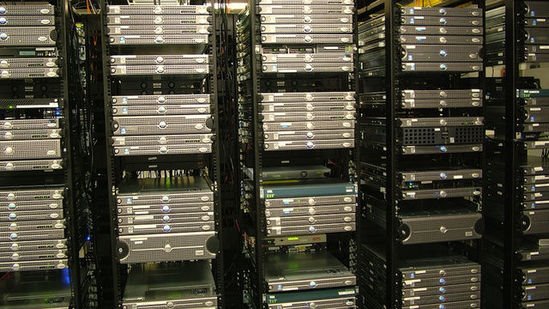
Data center
After cutting the fiber optic cables in Step 1, information can no longer be transmitted worldwide, and each region becomes an isolated island. Add the destruction of root servers, and network addresses become unparseable IP addresses. Only one step remains to destroy the internet: blowing up data centers.
Data centers are unremarkable buildings that house the servers allowing us to browse websites, send and receive emails, and chat and play games. These buildings are usually tall, and because they are not designed for people, most have no windows. The rooms holding the machines are usually dark and kept at low temperatures to keep the machines running properly.

60 Hudson Street, New York City
The building at 60 Hudson Street in New York City is an important hub of the global internet: the 9th floor of this building is 1,394 square meters, serving as a convergence point for local, national, and global multi-layer fiber optic cables. Servers, stored data, and network equipment are connected here, and a series of optical interfaces, coaxial cables, etc., connect to other networks through a series of patch panels. A data center like this is the physical center of the internet, essentially a giant Ethernet switch.
If this floor could be destroyed, the entire region's connections would break, and worldwide internet connections would be affected. Not only would certain websites themselves be erased, but data stored by some companies in data centers would also disappear. All the photos or songs you uploaded might cease to exist.
There are many data centers like this around the world. Currently, China has 9 hosted data centers: 2 in Beijing, 4 in Shanghai, and one each in Chengdu, Zhejiang, and Shenzhen.
Game over
Now the data has been completely frozen. All roads, bridges, and traffic lights have been destroyed; data can't go anywhere. What remains are some local area networks — they are networks, but no longer the internet. At this point, the internet has been successfully destroyed. Game over.
From the above, we can see the internet's strength and fragility. Of course, no one can attack all nodes of the global internet at the same time. Even if a team of thousands of people did it, the repair speed would likely exceed the destruction speed. Our purpose is not to actually destroy the internet, but to see from this how complex and interesting internet infrastructure is.
(Article translated from the Gizmodo website: How to Destroy the Internet by SAM BIDDLE)
(Source: Southern Weekly)