1. Concept of Enums:
C# Enum: An enum type is a basic data type (value type) used to declare a set of named constants.
2. Definition of Enums:
Declaring an enum variable:
enum <enum_name> {enumeration list};
Here, enum_name specifies the type name of the enum, and enumeration list is a comma-separated list of identifiers.
Each symbol in the enum list represents an integer value, one greater than the symbol preceding it. By default, the first enum symbol has a value of 0. For example:
enum Days {Sun , Mon, tue, Fir, sat };
3. Enum cases and usage of enum variables:
Example
namespace EnumApplication
{
class EnumProgram
{
enum Days { Sun, Mon, tue, Wed, thu, Fri, sat };
static void Main(string[] args)
{
int WeekdayStart = (int)Days.Mon;
int WeekdayEnd = (int)Days.Fir;
Console.WriteLine("Monday:{0}",WeekdayStart);
Console.WriteLine("Firday:{0}",WeekdayEnd );
Console.ReadKey();
}
}
}
4. Enum Class:
All enum types implicitly inherit the System.Enum type. System.Enum is the only reference type derived from System.ValueType that is not a value type.
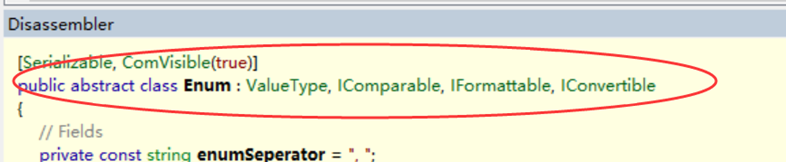
5. Enum Class:
| Method | Description |
|---|---|
| CompareTo | Compares this instance to a specified object and returns an indication of their relative values. |
| Equals: Indicates whether this instance equals a specified object. | |
| Format | Converts the specified value of the specified enum type to its equivalent string representation according to the specified format. |
| GetName | Retrieves the name of the constant that has the specified value in the specified enum. |
| GetNames | Retrieves an array of the names of the constants in the specified enum. |
| GetTypeCode | Returns the underlying TypeCode of this instance. |
| GetUnderlyingTye | Returns the underlying type of the specified enum. |
| GetValues | An array of the values of the constants in the specified enum. |
| HasFlag | Determines whether one or more bit fields are set in the current instance. |
| IsDefined | Returns an indication of whether a constant with the specified value exists in the specified enum. |
| Parse | Converts the string representation of the name or numeric value of one or more enum constants to an equivalent enum object; a parameter specifies whether the operation is case-insensitive. |
| TryParse | Converts the string representation of the name or numeric value of one or more enum constants to an equivalent enum object; a return value indicates whether the conversion succeeded. |
6. Flag Enum / Bit Enum
C# Flag Enum (Flags): An enum type is a basic type of data (value type) used to declare a set of named constants.
Enum values are mutually exclusive. A bit flag set, however, is a list formed by elements that appear in combinations, usually designed to combine new values using a "bitwise OR" operation.
An enum type usually expresses a semantically relatively independent set of numeric values. Using an enum type to implement a bit flag set is the most perfect combination, abbreviated as a bit enum.
7. Definition of Bit Enum
///<summary>
  /// 权限枚举
  ///</summary>
  [Flags]
  public enum permission                     注意加了[Flags]特性后有三种写法,
  {                                  一种是使用<<符号,
      Unknown = 0; // 也可以写成0x00或0             第二种是0x01,
                                    还有一种是直接写0,1,2,4,8....,
      Create = 1<<0, // 0x01或1                 一般来说是2的n次方来表示。
                                     注:<<左操作符,表示对这个数进行移位。
      Read = 1<<1,  //0x02或2

      Update = 1<<2, //0x04或4

      Delete = 1<<3  //0x08或8
  }
8. Example of Bit Enum
//1、给用户创建、读取,修改和删除的权限
var parmission = Permission.Create | parmission.Read | parmission.Update | parmission.Delete;

//2、去掉用户的修改和删除权限
parmission = parmission &~parmission.Update;
parmission = parmission &~parmission.Delete;

//3、给用户加上修改的权限
parmission = parmission | parmission.Update;

//4、判断用户是否有创建的权限
var isCreate = (parmission & parmission.Create)!=0;
//或者
var isCreate = (parmission & parmission.Create)==parmission.Create;
  这时parmission枚举的值将变成0+1+4=5,它的ToSting()将变成“parmission.Create,
  parmission.Read”,parmission.Update; 这里我们可以解释为什么第五个值Delete是8而不能成为5。
  也就是说它的值不应该是前几项值的复合值。一个比较简单的方法
  就是用2的n次方来依次位每一项赋值,例如:1,2,4,8,16,32,64.......。
Original address: https://www.cnblogs.com/chenyao-1424433719/p/11213658.html