Django introduction
Django is an open-source web application framework written in Python.
With Django, Python developers can easily complete most of what a production website requires with just a little code, and further develop full-featured web services.
Django provides the tools needed for full-stack development, including database ORM, template engine, routing system, user authentication, etc., greatly reducing repetitive code.
Django's Philosophy:
- DRY(Don't Repeat Yourself):Avoids repetitive code and promotes reuse (such as template inheritance and model inheritance).
- Convention over Configuration:Provides sensible configurations by default (such as an auto-generated Admin interface), reducing decision costs.
- Rapid development:Can be efficiently carried from prototype to production environment.
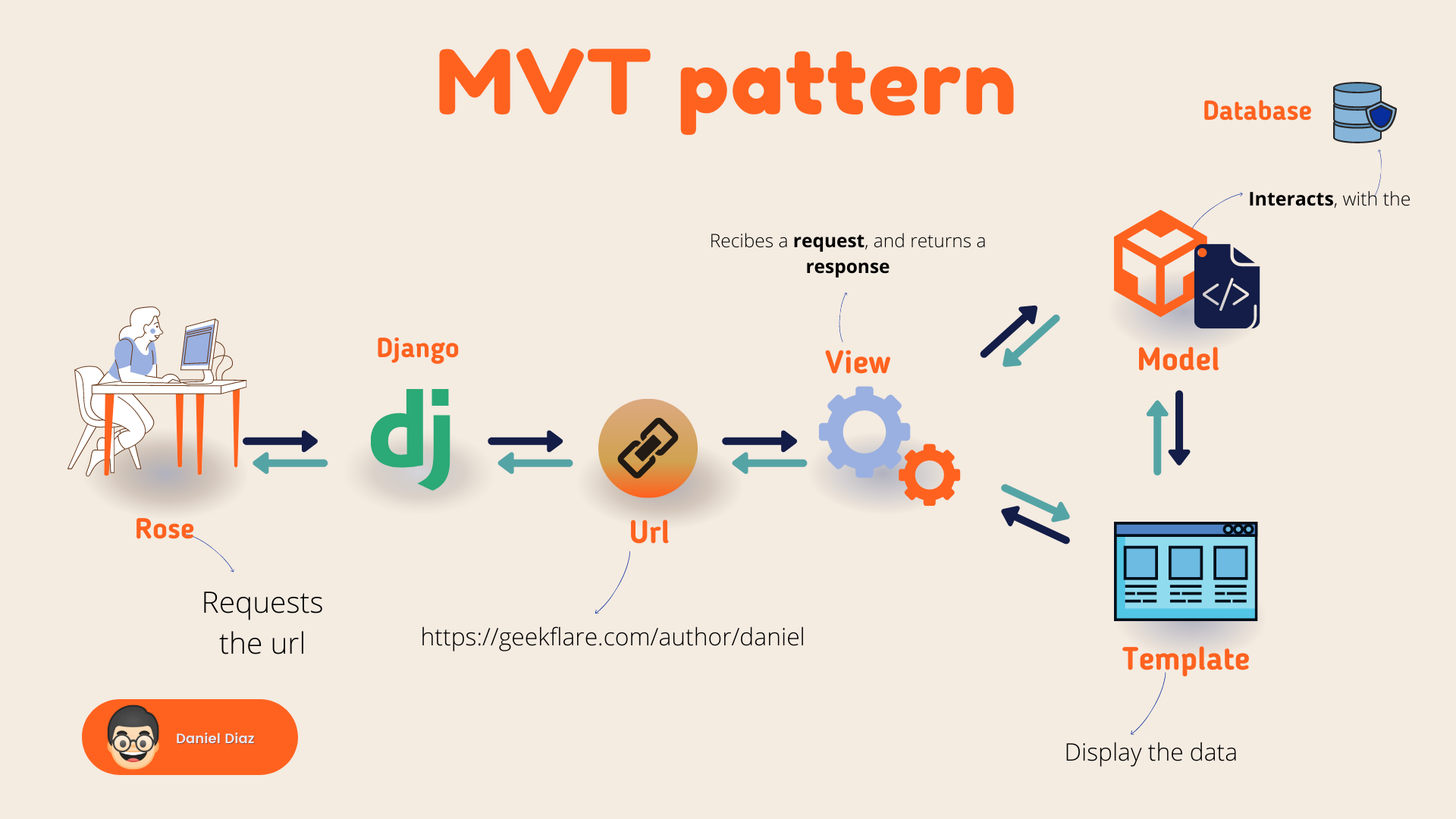
Django 遵循 MVC(Model-View-Controller)framestructure, butIn Django Medium更常ByCalled MTV(Model-Template-View)。
Built-in Features
| Features | Description |
|---|---|
| Admin backend | Automatically generates an admin interface, eliminating the need to manually write CRUD logic. |
| ORM | Use Python classes to operate the database without writing SQL. |
| Form Processing | Built-in form validation to prevent CSRF attacks. |
| User Authentication | Provides login, registration, and permission management (django.contrib.auth)。 |
| Routing System | Flexible URL mapping with support for regular expressions. |
| Cache Mechanism | Support backends such as Memcached, Redis. |
Core Features
- Rapid development:Django provides a wealth of built-in features, such as authentication, admin backend, and form handling, allowing developers to focus on business logic rather than low-level implementation.
- Automated admin backend:With just a simple model definition, a powerful admin interface can be generated, supporting create, read, update, and delete operations.
- ORM database mapping:Django's built-in ORM (Object-Relational Mapping) lets developers interact with the database using Python classes without writing SQL.
- Powerful URL routing:Use regular expressions to flexibly define URLs and easily implement page routing.
- Template engine:Built-in powerful template system supports logic judgment and loop processing, making it convenient to render HTML pages.
- Internationalization Support:Django supports multilingual internationalization, making it well-suited for global applications.
- High security:Built-in security measures, such as preventing SQL injection, XSS attacks, CSRF attacks, and more.
- Rich community and extensions:A large number of open-source third-party libraries, such as Django REST framework and Django CMS, allow rapid feature expansion.
MVC and MTV Models
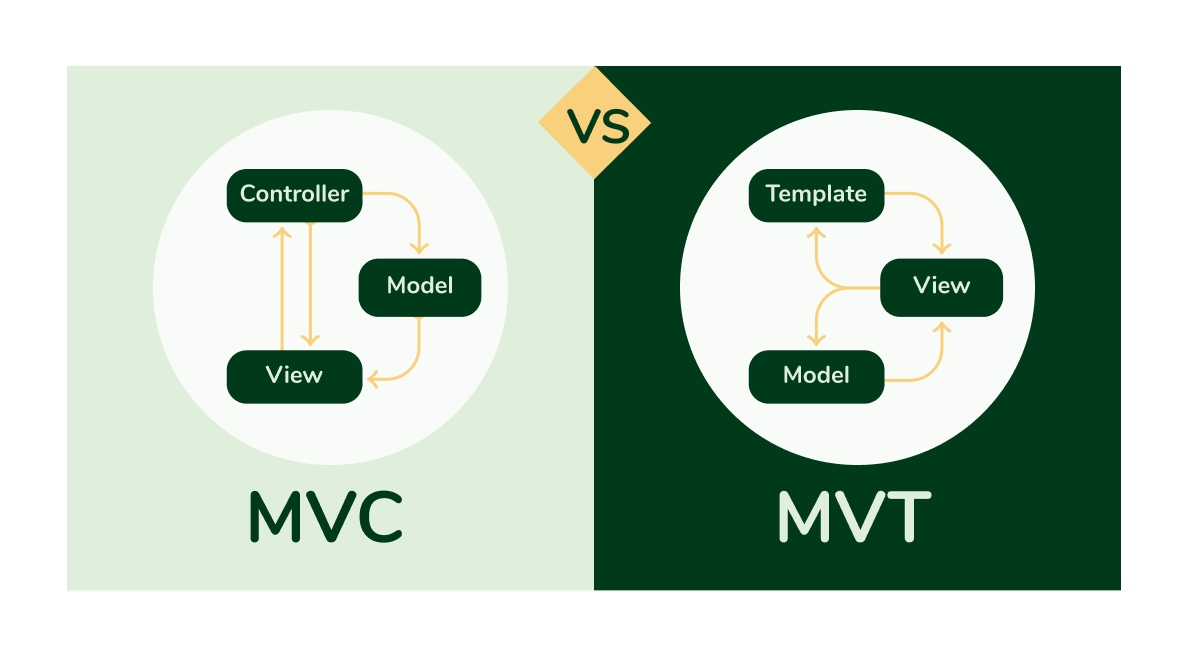
MVC (Model-View-Controller)
-
Model (model): Handles interaction with the database, defines data structure and business logic.
-
View: Responsible for data presentation, generating the HTML page that users see.
-
Controller: Receives user requests, calls the Model to process data, and passes the results to the View to render the page.
Process:
-
The user sends a request to the Controller.
-
The Controller handles logic and calls the Model to retrieve data.
-
The Controller passes the data to the View.
-
The View renders and returns the HTML page to the user.
MVT (Model-Template-View) — Django's implementation approach
Django adoptsMVTDesign pattern, similar to MVC, but with some differences:
-
Model (model): Interacts with the database to handle the creation, reading, updating, and deletion of data.
-
Template (template): Responsible for page rendering, generating the final HTML content.
-
View: Django's View is more like the controller role; it receives the request and decides which template and data to use.
Process:
-
User visits a URL, and the request is handled by Django's
urls.pyMaps to the corresponding View. -
View handles business logic and calls the Model to retrieve data.
-
The View passes the data to the Template.
-
Template renders the HTML and finally returns it to the user.
Applicable scenarios for Django
Projects suitable for Django:
- ✅ Content management systems (CMS) (e.g., news websites, blogs)
- ✅ Social platforms (user systems, activity publishing)
- ✅ E-commerce websites (order management, payment integration)
- ✅ API backend (integrated with Django REST framework)
Unsuitable Scenarios:
- ❌ Real-time systems with ultra-high performance requirements (e.g., high-frequency trading platforms; Go or Rust recommended)
- ❌ Extremely lightweight microservices (can consider Flask or FastAPI)
Django vs other frameworks
| Framework | Features |
|---|---|
| Flask | Lightweight and flexible, suitable for small projects or microservices. |
| FastAPI | Strong asynchronous support, suitable for high-performance API development. |
| Ruby on Rails | Similar to Django, but using the Ruby language. |
| Laravel | An MVC framework in the PHP ecosystem, with functionality similar to Django. |
Django advantages:
- "Out of the box": complete functionality can be achieved without installing additional plugins.
- Security: automatically protects against common attacks such as SQL injection, XSS, and CSRF.
- Active community: rich third-party libraries (such as Django REST framework and Django CMS).