C Recursion
Recursion refers to the method of using the function itself within the definition of a function.
For example:
Once upon a time, there was a mountain, and in the mountain there was a temple, and in the temple there was an old monk telling a story to a young monk! What was the story? "Once upon a time, there was a mountain, and in the mountain there was a temple, and in the temple there was an old monk telling a story to a young monk! What was the story? 'Once upon a time, there was a mountain, and in the mountain there was a temple, and in the temple there was an old monk telling a story to a young monk! What was the story? ...'"
The syntax format is as follows:
Flowchart:
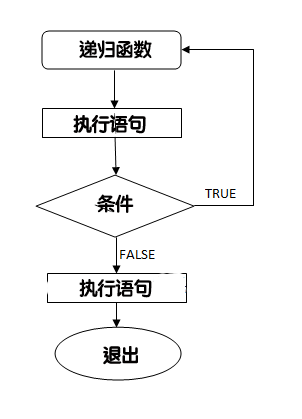
The C language supports recursion, meaning a function can call itself. However, when using recursion, programmers need to be careful to define a condition for exiting the function; otherwise, it will fall into an infinite loop.
Recursive functions play a crucial role in solving many mathematical problems, such as calculating the factorial of a number, generating the Fibonacci sequence, and so on.
Factorial of a number
The following example uses a recursive function to calculate the factorial of a given number:
Example
When the above code is compiled and executed, it produces the following results:
15 的阶乘为 1307674368000.000000
Fibonacci sequence
The following example uses a recursive function to generate the Fibonacci sequence for a given number:
Example
When the above code is compiled and executed, it produces the following results:
0
1
1
2
3
5
8
13
21
34
other extensions